1. YLJ01小型压片机
| 1.1 参数表 | |||||
| 型号 | YLJ01-10T(2柱) | YLJ01-15T(2柱) | YLJ01-15T(4柱) | YLJ01-24T(4柱) | YLJ01-30T(4柱) |
| 压力范围 | 0~10吨 | 0~15吨 | 0~15吨 | 0~24吨 | 0~30吨 |
| 压强范围 | 0~16.7MPa | 0~25MPa | 0~25MPa | 0~40MPa | 0~35MPa |
| 活塞直径 | 87mm | 87mm | 87mm | 87mm | 105mm |
| 最大活塞行程 | 20mm | 20mm | 20mm | 20mm | 20mm |
| 工作空间 | 140×140×120mm | 140×140×150mm | 94×94×150mm | 94×94×140mm | 140×140×150mm |
| 压力稳定性 | ≤1Mpa/5min | ≤1Mpa/5min | ≤1Mpa/5min | ≤1Mpa/5min | ≤1Mpa/5min |
| 净重 | 35kg | 35kg | 36kg | 40kg | 50kg |
| 毛重(含木箱) | 40kg | 40kg | 41kg | 45kg | 55kg |
| 外形尺寸 | 280×210×500mm | 280×210×500mm | 280×210×500mm | 280×260×500mm | 325×230×550mm |
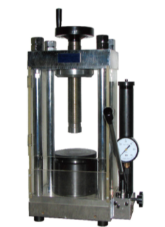
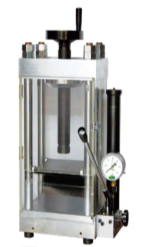
| 产品图片 | 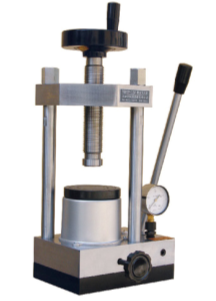 | 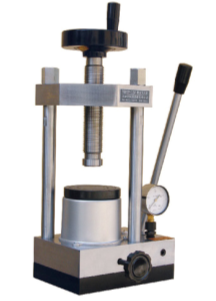 | 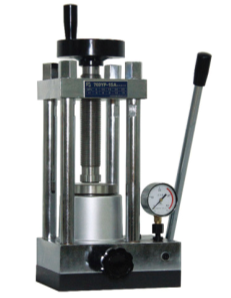 | 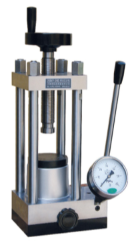 | 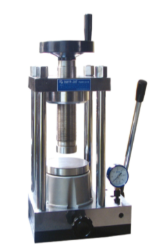 |
| 1.2 压力换算表 | ||||||||
| YLJ01-10T(2柱) | 油缸实际压力(吨) | 3 | 6 | 9 | 10 | / | / | / |
压力表示值(MPa) | 5 | 10 | 15 | 16.5 | / | / | / | |
| YLJ01-15T(4柱) | 油缸实际压力(吨) | 3 | 6 | 9 | 12 | 15 | / | / |
压力表示值(MPa) | 5 | 10 | 15 | 20 | 25 | / | / | |
| YLJ01-24T(4柱) | 油缸实际压力(吨) | 3 | 6 | 9 | 12 | 15 | 20 | 24 |
压力表示值(MPa) | 5 | 10 | 15 | 20 | 25 | 33.4 | 40 | |
| YLJ01-30T(4柱) | 油缸实际压力(吨) | 4.3 | 8.6 | 12.9 | 17.2 | 21.5 | 25.8 | 30 |
压力表示值(MPa) | 5 | 10 | 15 | 20 | 25 | 30 | 35 | |
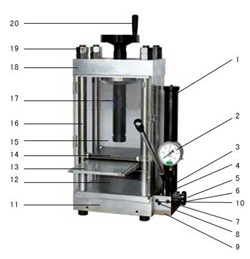
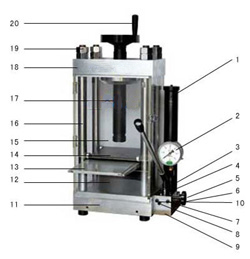
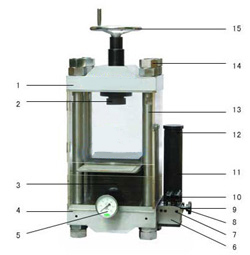
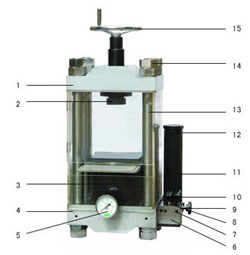
| 1.3 仪器结构 (图1.1) | |||
| No. | 名称 | No. | 名称 |
| 1 | 手轮 | 9 | 工作台 |
| 2 | 丝杠 | 10 | 压力表 |
| 3 | 螺母 | 11 | 手动压把 |
| 4 | 立柱 | 12 | 柱塞泵 |
| 5 | 顶盖 | 13 | 注油孔螺钉 |
| 6 | 大油缸 | 14 | 限位螺钉 |
| 7 | 大板 | 15 | 吸油阀 |
| 8 | 油池 | 16 | 出油阀 |
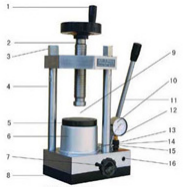 YLJ01-10T(2柱) | 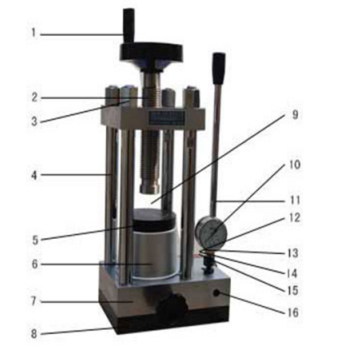 YLJ01-15T(4柱) | 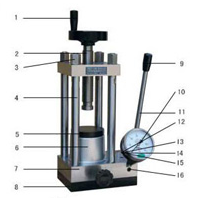 YLJ01-24T(4柱) | 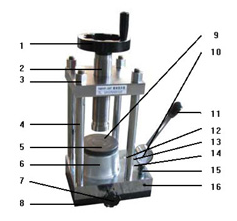 YLJ01-30T(4柱) |
【操作说明(见图1.1)】
先将注油孔螺钉13旋松,顺时针拧紧放油阀7,将模具置于工作台5的中央,用丝杠2拧紧后,前后摇动手动压把11,达到所需压力,保压后,逆时针松开放油阀7,取下模具即可。
【应用范围】
该仪器主要应用于红外分光光度计固体样品制样及各种小型粉末压片成型。广泛应用于催化、硅酸盐、电池、陶瓷及粉末冶金等行业。
【油路原理(见图1.2)】
工作时,放油阀7关闭。摆动手动压把11,油液从油池8中经单向阀15吸入,通过出油阀16压出进入大油缸6中,这样不断储存能量,从而形成高压油,并在压力表10中显示出来。当开启放油阀7,即可卸荷。
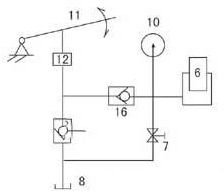
图1.2:YLJ01小型压片机油路图
【注意事项】
1. 使用前必须先松开注油孔螺钉13,压片机才能正常工作。
2. 请定期在丝杠2及柱塞泵12处加润滑油。
3. 加压决不允许超过机器的压力范围,否则会发生危险。
4. 压片机使用清洁的46号机油为宜,绝不可用刹车油。
5. 加压时,如果感觉手动压把11有力,但压力表10无指示,应立即卸荷并检查压力表10。
6. 新机器或较长段时间没有使用时,在使用之前要稍紧放油阀,加压到20~25MPa时即卸荷,连续重复2~3次,即可正常使用。
7. 大活塞6的行程不要超过20mm。
| 1.4 故障排除 | ||
| 故障现象 | 原因 | 排除方法 |
| 无压 | 1. 出油阀16内阀口钢柱密封不严或有异物。 2. 无油。 | 1. 用6mm内六角扳手旋开阀螺钉16,取出弹簧,再用一根6mm左右的铁棒或螺钉,一个头顶住钢珠,另一头附磁铁,吸出钢珠,清洗铁屑或异物,再依次复位。 2. 旋开阀螺钉15。 注入油后,用手指按住阀口,开动机器,感到非常有力时,再拧紧阀螺钉15即可。 3. 从注油孔加30号清洁机油。 |
上压不稳且慢 | 1. 漏油。 2. 放油阀7拧紧力不够。 3. 小柱塞泵12内有残余气体。 4. 大油缸6内有残余气体。 | 1. 检查漏油处,拧紧或排除。2.拧紧放油阀手轮。 3. 将整机后仰90°(即表面向上),摆动手柄11若干次(后仰时要拧紧注油孔螺钉13)。 4. 拧开顶部大螺钉,关紧放油阀7打压至油液溢出,再拧上顶部螺钉。 |
丝杠弯曲 | 1. YLJ01-15T加压超过25Mpa,YLJ01-24T加压超过40Mpa。 2.立柱大螺母松动 | 1. 调直或更换新丝杠。 2. 及时拧紧大螺母。 |
2. YLJ01中型压片机
| 2.1参数表 | ||
| 型号 | YLJ01-40T(4柱) | YLJ01-60T(4柱) |
| 压力范围 | 0~40吨 | 0~60吨 |
| 压强范围 | 0~33.3MPa | 0~34MPa |
| 活塞直径 | 125mm | 150mm |
| 最大活塞行程 | 40mm | 40mm |
| 工作空间 | 180×180×210mm | 220×220×260mm |
| 压力稳定性 | ≤1Mpa/5min | ≤1Mpa/5min |
| 净重 | 100kg | 155kg |
| 毛重(含木箱) | 105kg | 160kg |
| 外形尺寸 | 350×260×620mm | 445×240×740mm |
| 产品图片 |
|
|
| 2.2压力换算表 | ||||||||
| YLJ01-40T(4柱) | 油缸实际压力(吨) | 6 | 12 | 18 | 24 | 30 | 36 | 40 |
| 压力表示值(MPa) | 5 | 10 | 15 | 20 | 25 | 30 | 33.3 | |
| YLJ01-60T(4柱) | 油缸实际压力(吨) | 8.8 | 17.6 | 26.4 | 35.2 | 44 | 52.8 | 60 |
| 压力表示值(MPa) | 5 | 10 | 15 | 20 | 25 | 30 | 34 | |
| 2.3仪器结构(图2.1) | |||
| NO. | 名称 | NO. | 名称 |
| 1 | 油筒 | 11 | 主板 |
| 2 | 压力表 | 12 | 大活塞 |
| 3 | 低压阀 | 13 | 工作台导轨 |
| 4 | 小活塞 | 14 | 工作台 |
| 5 | 高压阀 | 15 | 防护罩 |
| 6 | 放油阀 | 16 | 立柱 |
| 7 | 高压阀 | 17 | 丝杠 |
| 8 | 低压溢流阀 | 18 | 上板 |
| 9 | 副板 | 19 | 螺母 |
| 10 | 低压阀 | 20 | 手轮 |
YLJ01-40T(4柱) |
YLJ01-60T(4柱) | ||
【操作说明(见图2.1)】
松开油筒1的螺钉,拧紧放油阀6,打开防护门15,拉出工作台14,将模具(或受压物品)放在工作台14上,再将工作台14推进去,用丝杠17将受压物品预紧,关上防护门15,摇动小活塞4的压把,给受压物品加压,压至所需压力后,松开放油阀6,将受压物品取出即可。
【应用范围】
该仪器主要应用于荧光光谱仪上固体样品制样及各种小型粉末压片成型。广泛应用于催化、硅酸盐、电池、陶瓷及粉末冶金等行业。
【油路原理(见图2.2)】
油筒1中的油,经小活塞4,再经低压阀3、10,高压阀5、7进入大活塞12,压力由压力表2显示,松开放油阀6,大活塞12中的油在压力的作用下回到油筒1中,大活塞12复位。
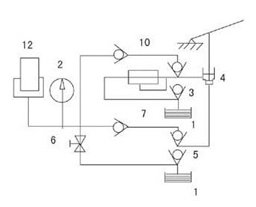
图2.2:YLJ01中型压片机油路图
【注意事项】
1.使用前必须将油筒1上的螺钉松开(运输时将此螺钉拧紧),松开放油阀6,摇动小活塞4的压把,空打数下以排除系统中的空气。
2.用丝杠17预紧受压物品时,力不要过大。
3.大活塞行程不能超过50mm。
4.维修时将油筒后座的阀关闭,以免油筒1里的油流出。
5.加压不允许超过其压力范围,以免发生危险。
6.油筒1里的油为46#机油。
| 2.4故障排除 | ||
| 故障现象 | 原因 | 排除方法 |
| 无压 | 1.漏油。 2.放油阀没拧紧。 | 1.更换密封垫,解决漏油处。 2.拧紧。 3.将大活塞压至最底部。 |
| 掉压 | 1.漏油。 2.放油阀口处不严或有异物。 3.大活塞3内有残余气体。 | 1.找出微小漏油处,进行排除。 2.关闭维修螺钉,然后拧出放油阀杆,用磁铁连接6mm铁棒吸出钢珠,用铁棒一端顶住钢珠,用榔头轻砸铁棒外露出一端,使阀口密封紧密,然后复位。 3.旋开活塞顶部的螺钉,并旋紧放油阀手轮,打压至液体油溢出。 |
| 机器变形 | 1.压力较高,并长期频繁使用,立柱大螺母松动。 2.超过允许压力。 | 1.拧紧立柱或立柱螺母。 2.降低使用压力,否则会损坏机器及发生安全事故。 |
3. YLJ01大型压片机
| 3.1参数表 | ||
| 型号 | YLJ01-100T(4柱) | YLJ01-150T(4柱) |
| 压力范围 | 0~100吨 | 0~150吨 |
| 压强范围 | 0~39.3MPa | 0~47.8MPa |
| 活塞直径 | 180mm | 200mm |
| 最大活塞行程 | 50mm | 50mm |
| 工作空间 | 220×220×280mm | 250×250×320mm |
| 压力稳定性 | ≤1Mpa/5min | ≤1Mpa/5min |
| 净重 | 220kg | 310kg |
| 毛重(含木箱) | 225kg | 315kg |
| 外形尺寸 | 480×300×840mm | 560×425×950mm |
| 产品图片 | 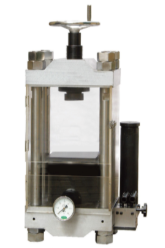 | 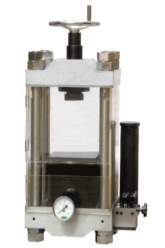 |
| 3.2压力换算表 | |||||||||||
| YLJ01-100T(4柱) | 油缸实际压力(吨) | 12.7 | 25.4 | 38.1 | 50.9 | 76.3 | 89 | 100 | / | / | / |
| 压力表示值(MPa) | 5 | 10 | 15 | 20 | 25 | 30 | 39.3 | / | / | / | |
| YLJ01-150T(4柱) | 油缸实际压力(吨) | 15.7 | 31.4 | 47.1 | 62.8 | 78.5 | 92.4 | 109.9 | 123.4 | 141.3 | 150 |
| 压力表示值(MPa) | 5 | 10 | 15 | 20 | 25 | 30 | 35 | 39.3 | 45 | 47.8 | |
| 3.3仪器结构(图3.1) | |||
| NO. | 名称 | NO. | 名称 |
| 1 | 上板 | 9 | 放油阀 |
| 2 | 丝杠 | 10 | 压力把A |
| 3 | 主油缸 | 11 | 压力把B |
| 4 | 主板 | 12 | 放气螺钉 |
| 5 | 压力表 | 13 | 立柱 |
| 6 | 副板 | 14 | 螺母 |
| 7 | 高压阀 | 15 | 手轮 |
| 8 | 低压阀 | 16 | 维修螺钉(背面) |
YLJ01-100T(4柱) |
YLJ01-150T(4柱) | ||
【操作说明(见图3.1)】
(1)松开放油筒顶部放气密封螺钉12和维修螺钉16,并逆时针旋松放油阀手轮,摆动快速复合油泵A及高压油泵B手柄各2~3下,使油路系统工作顺畅。
(2)用丝杠缓慢将工作台压至最低部,然后将丝杠旋紧。
(3)将模具或所压物品放置工作台,用丝杠进行预紧。
(4)顺时针旋紧放油阀手轮9,关好防护门。
(5)先摆动快速复合泵A升至14MPa左右,再改用高压泵8升至所需压力。
(6)压制完成后,逆时针旋松放油阀手轮,取出模具或所压物品。
【应用范围】
该仪器主要应用于需要大压力才能成型的样品,例如陶瓷、金属粉末等各种大型尺寸模具使用。
【油路原理(见图3.2)】
当需要升压时,先将放油阀E关闭,摇动快速复合柱塞泵A使复合泵大,小泵将油从油筒D分别经单向阀A1,A1*吸入,再经单向阀A2*,A3*;A2、A3进入工作缸C,并在压力表F中显示,其中大泵在超过2MPa时经逆流阀G泄流
小泵打到大约14MPa 改用高压泵B加压,此时油经单向阀B1,B2,B3进入工作缸C增压,直至打到所需压力。
注意:不要超过机器设定的最大压力(40MPa或48MPa)。
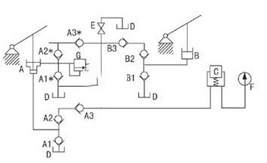
图3.2:YLJ01大型压片机油路图
【注意事项】
1.使用前必须先松开油筒上的放气螺钉12和维修螺钉16,再松开放油阀的状态下空打两柱塞,使系统正常工作。
2.每次使用前及使用中,都应把工作台用丝杠压至最底部。
3.保持机油的清洁,尤其是大小活塞滑动处,丝杠要定期加油润滑。
4.如发生渗漏及维修,要及时补充压力油,使之达到距油筒顶部100mm以内,压力油为46#清洁机油。
5.随时检查压力示值,决不允许超压使用,否则会发生危险。
6.大活塞6不要超过行程50mm。
| 3.4故障排除 | ||
| 故障现象 | 原因 | 排除方法 |
| 无压 | 1.漏油。 2.放油阀没拧紧。 | 1.更换密封垫,解决漏油处。 2.拧紧。 3.将大活塞压至最底部。 |
| 掉压 | 1.漏油。 2.放油阀口处不严或有异物。 3.大活塞3内有残余气体。 | 1.找出微小漏油处,进行排除。 2.关闭维修螺钉,然后拧出放油阀杆,用磁铁连接6mm铁棒吸出钢珠,用铁棒一端顶住钢珠,用榔头轻砸铁棒外露出一端,使阀口密封紧密,然后复位。 3.旋开活塞顶部的螺钉,并旋紧放油阀手轮,打压至液体油溢出。 |
| 机器变形 | 1.压力较高,并长期频繁使用,立柱大螺母松动。 2.超过允许压力。 | 1.拧紧立柱或立柱螺母。 2.降低使用压力,否则会损坏机器及发生安全事故。 |
1. YLJ01小型压片机
| 1.1 参数表 | |||||
| 型号 | YLJ01-10T (2柱) | YLJ01-15T (2柱) | YLJ01-15T (4柱) | YLJ01-24T (4柱) | YLJ01-30T(4柱) |
| 压力范围 | 0~10吨 | 0~15吨 | 0~15吨 | 0~24吨 | 0~30吨 |
| 压强范围 | 0~16.7MPa | 0~25MPa | 0~25MPa | 0~40MPa | 0~35MPa |
| 活塞直径 | 87mm | 87mm | 87mm | 87mm | 105mm |
| 最大活塞行程 | 20mm | 20mm | 20mm | 20mm | 20mm |
| 工作空间(mm) | 140×140×120 | 140×140×150 | 94×94×150 | 94×94×140 | 140×140×150 |
| 压力稳定性 | ≤1Mpa/5min | ≤1Mpa/5min | ≤1Mpa/5min | ≤1Mpa/5min | ≤1Mpa/5min |
| 净重 | 35kg | 35kg | 36kg | 40kg | 50kg |
| 毛重(含木箱) | 40kg | 40kg | 41kg | 45kg | 55kg |
| 外形尺寸(mm) | 280×210×500 | 280×210×500 | 280×210×500 | 280×260×500 | 325×230×550 |
| 产品图片 | | | | | |
| 1.2 压力换算表 | ||||||||
| YLJ01-10T(2柱) | 油缸实际压力(吨) | 3 | 6 | 9 | 10 | / | / | / |
压力表示值(MPa) | 5 | 10 | 15 | 16.5 | / | / | / | |
| YLJ01-15T(4柱) | 油缸实际压力(吨) | 3 | 6 | 9 | 12 | 15 | / | / |
压力表示值(MPa) | 5 | 10 | 15 | 20 | 25 | / | / | |
| YLJ01-24T(4柱) | 油缸实际压力(吨) | 3 | 6 | 9 | 12 | 15 | 20 | 24 |
压力表示值(MPa) | 5 | 10 | 15 | 20 | 25 | 33.4 | 40 | |
| YLJ01-30T(4柱) | 油缸实际压力(吨) | 4.3 | 8.6 | 12.9 | 17.2 | 21.5 | 25.8 | 30 |
压力表示值(MPa) | 5 | 10 | 15 | 20 | 25 | 30 | 35 | |
| 1.3 仪器结构 (图1.1) | |||
| No. | 名称 | No. | 名称 |
| 1 | 手轮 | 9 | 工作台 |
| 2 | 丝杠 | 10 | 压力表 |
| 3 | 螺母 | 11 | 手动压把 |
| 4 | 立柱 | 12 | 柱塞泵 |
| 5 | 顶盖 | 13 | 注油孔螺钉 |
| 6 | 大油缸 | 14 | 限位螺钉 |
| 7 | 大板 | 15 | 吸油阀 |
| 8 | 油池 | 16 | 出油阀 |
YLJ01-10T(2柱) | YLJ01-15T(4柱) | YLJ01-24T(4柱) | YLJ01-30T(4柱) |
【操作说明(见图1.1)】
先将注油孔螺钉13旋松,顺时针拧紧放油阀7,将模具置于工作台5的中央,用丝杠2拧紧后,前后摇动手动压把11,达到所需压力,保压后,逆时针松开放油阀7,取下模具即可。
【应用范围】
该仪器主要应用于红外分光光度计固体样品制样及各种小型粉末压片成型。广泛应用于催化、硅酸盐、电池、陶瓷及粉末冶金等行业。
【油路原理(见图1.2)】
工作时,放油阀7关闭。摆动手动压把11,油液从油池8中经单向阀15吸入,通过出油阀16压出进入大油缸6中,这样不断储存能量,从而形成高压油,并在压力表10中显示出来。当开启放油阀7,即可卸荷。
图1.2:YLJ01小型压片机油路图
【注意事项】
1. 使用前必须先松开注油孔螺钉13,压片机才能正常工作。
2. 请定期在丝杠2及柱塞泵12处加润滑油。
3. 加压决不允许超过机器的压力范围,否则会发生危险。
4. 压片机使用清洁的46号机油为宜,绝不可用刹车油。
5. 加压时,如果感觉手动压把11有力,但压力表10无指示,应立即卸荷并检查压力表10。
6. 新机器或较长段时间没有使用时,在使用之前要稍紧放油阀,加压到20~25MPa时即卸荷,连续重复2~3次,即可正常使用。
7. 大活塞6的行程不要超过20mm。
| 1.4 故障排除 | ||
| 故障现象 | 原因 | 排除方法 |
| 无压 | 1. 出油阀16内阀口钢柱密封不严或有异物。 2. 无油。 | 1. 用6mm内六角扳手旋开阀螺钉16,取出弹簧,再用一根6mm左右的铁棒或螺钉,一个头顶住钢珠,另一头附磁铁,吸出钢珠,清洗铁屑或异物,再依次复位。 2. 旋开阀螺钉15。 注入油后,用手指按住阀口,开动机器,感到非常有力时,再拧紧阀螺钉15即可。 3. 从注油孔加30号清洁机油。 |
上压不稳且慢 | 1. 漏油。 2. 放油阀7拧紧力不够。 3. 小柱塞泵12内有残余气体。 4. 大油缸6内有残余气体。 | 1. 检查漏油处,拧紧或排除。2.拧紧放油阀手轮。 3. 将整机后仰90°(即表面向上),摆动手柄11若干次(后仰时要拧紧注油孔螺钉13)。 4. 拧开顶部大螺钉,关紧放油阀7打压至油液溢出,再拧上顶部螺钉。 |
丝杠弯曲 | 1. YLJ01-15T加压超过25Mpa,YLJ01-24T加压超过40Mpa。 2.立柱大螺母松动 | 1. 调直或更换新丝杠。 2. 及时拧紧大螺母。 |
2. YLJ01中型压片机
| 2.1参数表 | ||
| 型号 | YLJ01-40T(4柱) | YLJ01-60T(4柱) |
| 压力范围 | 0~40吨 | 0~60吨 |
| 压强范围 | 0~33.3MPa | 0~34MPa |
| 活塞直径 | 125mm | 150mm |
| 最大活塞行程 | 40mm | 40mm |
| 工作空间 | 180×180×210mm | 220×220×260mm |
| 压力稳定性 | ≤1Mpa/5min | ≤1Mpa/5min |
| 净重 | 100kg | 155kg |
| 毛重(含木箱) | 105kg | 160kg |
| 外形尺寸 | 350×260×620mm | 445×240×740mm |
| 产品图片 |
|
|
| 2.2压力换算表 | ||||||||
| YLJ01-40T(4柱) | 油缸实际压力(吨) | 6 | 12 | 18 | 24 | 30 | 36 | 40 |
| 压力表示值(MPa) | 5 | 10 | 15 | 20 | 25 | 30 | 33.3 | |
| YLJ01-60T(4柱) | 油缸实际压力(吨) | 8.8 | 17.6 | 26.4 | 35.2 | 44 | 52.8 | 60 |
| 压力表示值(MPa) | 5 | 10 | 15 | 20 | 25 | 30 | 34 | |
| 2.3仪器结构(图2.1) | |||
| NO. | 名称 | NO. | 名称 |
| 1 | 油筒 | 11 | 主板 |
| 2 | 压力表 | 12 | 大活塞 |
| 3 | 低压阀 | 13 | 工作台导轨 |
| 4 | 小活塞 | 14 | 工作台 |
| 5 | 高压阀 | 15 | 防护罩 |
| 6 | 放油阀 | 16 | 立柱 |
| 7 | 高压阀 | 17 | 丝杠 |
| 8 | 低压溢流阀 | 18 | 上板 |
| 9 | 副板 | 19 | 螺母 |
| 10 | 低压阀 | 20 | 手轮 |
YLJ01-40T(4柱) |
YLJ01-60T(4柱) | ||
【操作说明(见图2.1)】
松开油筒1的螺钉,拧紧放油阀6,打开防护门15,拉出工作台14,将模具(或受压物品)放在工作台14上,再将工作台14推进去,用丝杠17将受压物品预紧,关上防护门15,摇动小活塞4的压把,给受压物品加压,压至所需压力后,松开放油阀6,将受压物品取出即可。
【应用范围】
该仪器主要应用于荧光光谱仪上固体样品制样及各种小型粉末压片成型。广泛应用于催化、硅酸盐、电池、陶瓷及粉末冶金等行业。
【油路原理(见图2.2)】
油筒1中的油,经小活塞4,再经低压阀3、10,高压阀5、7进入大活塞12,压力由压力表2显示,松开放油阀6,大活塞12中的油在压力的作用下回到油筒1中,大活塞12复位。
图2.2:YLJ01中型压片机油路图
【注意事项】
1.使用前必须将油筒1上的螺钉松开(运输时将此螺钉拧紧),松开放油阀6,摇动小活塞4的压把,空打数下以排除系统中的空气。
2.用丝杠17预紧受压物品时,力不要过大。
3.大活塞行程不能超过50mm。
4.维修时将油筒后座的阀关闭,以免油筒1里的油流出。
5.加压不允许超过其压力范围,以免发生危险。
6.油筒1里的油为46#机油。
| 2.4故障排除 | ||
| 故障现象 | 原因 | 排除方法 |
| 无压 | 1.漏油。 2.放油阀没拧紧。 | 1.更换密封垫,解决漏油处。 2.拧紧。 3.将大活塞压至最底部。 |
| 掉压 | 1.漏油。 2.放油阀口处不严或有异物。 3.大活塞3内有残余气体。 | 1.找出微小漏油处,进行排除。 2.关闭维修螺钉,然后拧出放油阀杆,用磁铁连接6mm铁棒吸出钢珠,用铁棒一端顶住钢珠,用榔头轻砸铁棒外露出一端,使阀口密封紧密,然后复位。 3.旋开活塞顶部的螺钉,并旋紧放油阀手轮,打压至液体油溢出。 |
| 机器变形 | 1.压力较高,并长期频繁使用,立柱大螺母松动。 2.超过允许压力。 | 1.拧紧立柱或立柱螺母。 2.降低使用压力,否则会损坏机器及发生安全事故。 |
3. YLJ01大型压片机
| 3.1参数表 | ||
| 型号 | YLJ01-100T(4柱) | YLJ01-150T(4柱) |
| 压力范围 | 0~100吨 | 0~150吨 |
| 压强范围 | 0~39.3MPa | 0~47.8MPa |
| 活塞直径 | 180mm | 200mm |
| 最大活塞行程 | 50mm | 50mm |
| 工作空间 | 220×220×280mm | 250×250×320mm |
| 压力稳定性 | ≤1Mpa/5min | ≤1Mpa/5min |
| 净重 | 220kg | 310kg |
| 毛重(含木箱) | 225kg | 315kg |
| 外形尺寸 | 480×300×840mm | 560×425×950mm |
| 产品图片 | | |
| 3.2压力换算表 | |||||||||||
| YLJ01-100T(4柱) | 油缸实际压力(吨) | 12.7 | 25.4 | 38.1 | 50.9 | 76.3 | 89 | 100 | / | / | / |
| 压力表示值(MPa) | 5 | 10 | 15 | 20 | 25 | 30 | 39.3 | / | / | / | |
| YLJ01-150T(4柱) | 油缸实际压力(吨) | 15.7 | 31.4 | 47.1 | 62.8 | 78.5 | 92.4 | 109.9 | 123.4 | 141.3 | 150 |
| 压力表示值(MPa) | 5 | 10 | 15 | 20 | 25 | 30 | 35 | 39.3 | 45 | 47.8 | |
| 3.3仪器结构(图3.1) | |||
| NO. | 名称 | NO. | 名称 |
| 1 | 上板 | 9 | 放油阀 |
| 2 | 丝杠 | 10 | 压力把A |
| 3 | 主油缸 | 11 | 压力把B |
| 4 | 主板 | 12 | 放气螺钉 |
| 5 | 压力表 | 13 | 立柱 |
| 6 | 副板 | 14 | 螺母 |
| 7 | 高压阀 | 15 | 手轮 |
| 8 | 低压阀 | 16 | 维修螺钉(背面) |
YLJ01-100T(4柱) |
YLJ01-150T(4柱) | ||
【操作说明(见图3.1)】
(1)松开放油筒顶部放气密封螺钉12和维修螺钉16,并逆时针旋松放油阀手轮,摆动快速复合油泵A及高压油泵B手柄各2~3下,使油路系统工作顺畅。
(2)用丝杠缓慢将工作台压至最低部,然后将丝杠旋紧。
(3)将模具或所压物品放置工作台,用丝杠进行预紧。
(4)顺时针旋紧放油阀手轮9,关好防护门。
(5)先摆动快速复合泵A升至14MPa左右,再改用高压泵8升至所需压力。
(6)压制完成后,逆时针旋松放油阀手轮,取出模具或所压物品。
【应用范围】
该仪器主要应用于需要大压力才能成型的样品,例如陶瓷、金属粉末等各种大型尺寸模具使用。
【油路原理(见图3.2)】
当需要升压时,先将放油阀E关闭,摇动快速复合柱塞泵A使复合泵大,小泵将油从油筒D分别经单向阀A1,A1*吸入,再经单向阀A2*,A3*;A2、A3进入工作缸C,并在压力表F中显示,其中大泵在超过2MPa时经逆流阀G泄流
小泵打到大约14MPa 改用高压泵B加压,此时油经单向阀B1,B2,B3进入工作缸C增压,直至打到所需压力。
注意:不要超过机器设定的最大压力(40MPa或48MPa)。
图3.2:YLJ01大型压片机油路图
【注意事项】
1.使用前必须先松开油筒上的放气螺钉12和维修螺钉16,再松开放油阀的状态下空打两柱塞,使系统正常工作。
2.每次使用前及使用中,都应把工作台用丝杠压至最底部。
3.保持机油的清洁,尤其是大小活塞滑动处,丝杠要定期加油润滑。
4.如发生渗漏及维修,要及时补充压力油,使之达到距油筒顶部100mm以内,压力油为46#清洁机油。
5.随时检查压力示值,决不允许超压使用,否则会发生危险。
6.大活塞6不要超过行程50mm。
| 3.4故障排除 | ||
| 故障现象 | 原因 | 排除方法 |
| 无压 | 1.漏油。 2.放油阀没拧紧。 | 1.更换密封垫,解决漏油处。 2.拧紧。 3.将大活塞压至最底部。 |
| 掉压 | 1.漏油。 2.放油阀口处不严或有异物。 3.大活塞3内有残余气体。 | 1.找出微小漏油处,进行排除。 2.关闭维修螺钉,然后拧出放油阀杆,用磁铁连接6mm铁棒吸出钢珠,用铁棒一端顶住钢珠,用榔头轻砸铁棒外露出一端,使阀口密封紧密,然后复位。 3.旋开活塞顶部的螺钉,并旋紧放油阀手轮,打压至液体油溢出。 |
| 机器变形 | 1.压力较高,并长期频繁使用,立柱大螺母松动。 2.超过允许压力。 | 1.拧紧立柱或立柱螺母。 2.降低使用压力,否则会损坏机器及发生安全事故。 |
1. 手机淘宝(官方淘宝店铺:科学材料站)
2. 点击进入淘宝网页链接
YLJ 手动粉末压片机 (01系列) | |||
产品代码 | 产品描述 | 产品价格及规格 | 库存状态 |
| 2902001-1 | YLJ01-10T 手动粉末压片机 (2柱) | 请询价 | 请咨询 |
| 2902001-2 | YLJ01-15T 手动粉末压片机 (2柱) | 请询价 | 请咨询 |
| 2902001-3 | YLJ01-15T 手动粉末压片机 (4柱) | 请询价 | 请咨询 |
| 2902001-4 | YLJ01-24T 手动粉末压片机 (4柱) | 请询价 | 请咨询 |
| 2902001-5 | YLJ01-30T 手动粉末压片机 (4柱) | 请询价 | 请咨询 |
| 2902001-6 | YLJ01-40T 手动粉末压片机 (4柱) | 请询价 | 请咨询 |
| 2902001-7 | YLJ01-60T 手动粉末压片机 (4柱) | 请询价 | 请咨询 |
| 2902001-8 | YLJ01-100T 手动粉末压片机 (4柱) | 请询价 | 请咨询 |
| 2902001-9 | YLJ01-150T 手动粉末压片机 (4柱) | 请询价 | 请咨询 |
| SCI Materials Hub is Committed to Offerig The Best Price & Customer Services! | |||
*大量需求请联系我们咨询更多折扣
**可提供13%增值税专用发票
3. 其它联系方式
电话:+86 130-0303-8751/+86 156-0553-2352
微信:SCI-Materials-Hub
如需报价单请联系:Email: contact@scimaterials.cn
SCI MATERIALS HUB
科研选材,选科学材料站
材料规格清晰,应用文献可查
Supplier names in the literature include SCI Materials Hub, Wuhu Eryi Materials Technology (an SCI Materials Hub company), Owl Materials Technology (an SCI Materials Hub company), and Wuhu Maotouying Materials Technology (an SCI Materials Hub company).
没有符合当前筛选条件的文献。
With nickel foam supplied by Wuhu Owl Materials Technology (an SCI Materials Hub company), the team built a core–shell cobalt selenide–hydroxide electrode for supercapacitors.
The authors sourced nickel foam from SCI Materials Hub and used a hydrogen-bond-regulated interface to improve seawater oxidation and durability.
The experiments used Fumasep FAB-PK-130 membrane from SCI Materials Hub, and the authors developed a co-deposited PdCu catalyst for electrochemical semi-hydrogenation of alkynols.
With Nafion D520 dispersion supplied by SCI Materials Hub, the researchers made an interface-rich nickel–cobalt alloy by flash Joule heating for alkaline hydrogen evolution.
The experiments used Vulcan XC-72 carbon black from SCI Materials Hub, and the authors improved CO tolerance in methanol oxidation by decorating porous platinum nanorods with amorphous bismuth sulfide.
The authors improved CO₂ electroreduction selectivity with high-index copper facets in Ag–Cu tandem catalysts in experiments that used Nafion NR212 membrane from SCI Materials Hub.
The experiments used 0.3 mm nickel foam from Wuhu Owl Materials Technology (an SCI Materials Hub company), and the authors built a binder-free NiTe₂/CoTe₂ electrode for chloride removal by capacitive deionization.
The study used AvCarb MB30 gas diffusion layer from SCI Materials Hub, and the team improved proton-exchange membrane fuel cells with an ionomer that interacts with surface dipoles.
The researchers characterized the structure, hardness, and ion release of a zinc-modified titanium alloy, with zinc nanopowder (about 50 nm) supplied by SCI Materials Hub.
The authors sourced carbon cloth from SCI Materials Hub and developed a porous hydrogel that improves moisture-driven power generation.
The experiments used Sigracet 28BC carbon paper and Nafion D520 dispersion from SCI Materials Hub, and the authors identified how calcium deposits affect oxygen reduction during peroxide electrosynthesis in natural water.
With Toray TGP-H-060 carbon paper and Nafion NR211 membrane supplied by SCI Materials Hub, the researchers improved nitrate reduction by introducing isolated antimony sites that promote lattice-nitrogen participation.
The authors separated the effects of platinum surface functionalization on cathode kinetics and mass transport in experiments that used GORE-SELECT M788.12 membrane and AvCarb GDS3250 carbon paper from SCI Materials Hub.
The study used Ketjenblack EC-300J carbon black from SCI Materials Hub, and the team reduced Nafion-induced poisoning of Pt₃Co fuel-cell catalysts by adding cerium.
The researchers reversed hydrogen spillover by tuning oxygen vacancies to improve interfacial hydrogen transfer, with Toray TGP-H-060H hydrophilic carbon paper supplied by SCI Materials Hub.
The authors sourced PiperION A35 membrane from SCI Materials Hub and evaluated crown ether-based membranes for durable alkaline electrolysis under fluctuating power.
The researchers used stainless-steel current collectors from Wuhu Maotouying Materials Technology (an SCI Materials Hub company) and improved aqueous zinc-battery cycling by regulating stress in manganese-substituted VOPO₄.
The experiments used copper foam from SCI Materials Hub, and the authors used interfacial ligands to improve both activity and selectivity in alkynol semi-hydrogenation and deuteration.
With Sustainion XA-9 ionomer dispersion supplied by SCI Materials Hub, the researchers showed how dynamic coordination in zinc–phosphorus nanodomains affects CO₂ reduction.
The authors demonstrated hydrogen peroxide electrosynthesis with a resin-wafer reactor without an anion-exchange membrane in experiments that used Hesen HCP135 carbon paper, Accelerate IrO₂, BP2000 carbon black, Nafion N115 membrane, Nafion D520 dispersion, and Sustainion X37-50 Grade RT membrane from SCI Materials Hub.
The study used Nafion NR211 membrane, PiperION A20 membrane, Nafion D521 dispersion, PiperION A25-HCO₃ ionomer dispersion, wet-proofed Toray TGP-H-090 carbon paper, and stainless steel fiber paper from SCI Materials Hub, and the team showed how surface hydroxyl structure governs water dissociation in bipolar membranes.
The researchers demonstrated salt-free hydrogen peroxide electrosynthesis in neutral electrolyte with confined Co–N₄ sites, with AvCarb GDS2230 carbon paper supplied by SCI Materials Hub.
The authors sourced copper foam from SCI Materials Hub and engineered fluorine-induced defects in Cu₃P to improve chloride removal.
The experiments used Toray TGP-H-060H(S) hydrophilic carbon paper from SCI Materials Hub, and the authors improved hydrogen evolution by tuning electronic coupling between ruthenium nanoclusters and ReS₂ nanosheets.
With 99.99% magnesium foil (200 µm) supplied by SCI Materials Hub, the researchers evaluated how albumin and shear stress affect corrosion of polymer-coated magnesium under simulated physiological flow.
The authors evaluated the performance and economics of vanadium flow batteries for long-duration storage in experiments that used Nafion NR212 membrane from SCI Materials Hub.
The researchers used commercial cation-selective membranes from Owl Materials Technology (an SCI Materials Hub company) and evaluated edge-sulfonated graphene oxide membranes for osmotic power generation.
The study used Johnson Matthey 20 wt% Pt/C catalyst, TANAKA PtCo/C catalyst (46.9 wt% Pt), and Ketjenblack EC-300J carbon black from SCI Materials Hub, and the team improved phosphate tolerance in a low-platinum, high-temperature PEM fuel cell.
The researchers improved CO₂-to-n-propanol conversion by combining nanoconfinement with grain-boundary engineering, with Nafion N115 membrane supplied by SCI Materials Hub.
The authors sourced Nafion D520 dispersion from SCI Materials Hub and developed a cobalt phosphide catalyst supported on nitrogen-doped coconut-shell carbon for alkaline hydrogen evolution.
The experiments used Sustainion ionomer dispersion (5 wt%) and Fumion FAA-3 ionomer (10 wt%) from SCI Materials Hub, and the authors demonstrated peroxide production from natural seawater at industrially relevant current densities.
With Toray TGP-H-060M carbon paper supplied by SCI Materials Hub, the researchers adjusted the CO-to-hydrogen ratio of syngas with Cu–In–Ag electrodes.
The authors favored multicarbon products in CO₂ electroreduction with a CuLa bimetallic catalyst in experiments that used Nafion perfluorinated resin solution (5–5.4 wt%) from SCI Materials Hub.
The study used Fumasep FKS-30 membrane from SCI Materials Hub, and the team improved electroosmotic flow in microfluidic chips through microscale pumping.
The experiments used 5 wt% Nafion dispersion and commercial Nafion membrane from Wuhu Eryi Materials Technology (an SCI Materials Hub company), and the authors developed an amino acid-functionalized membrane with higher proton conductivity and lower methanol permeability.
The researchers developed an amorphous NiCoFeMo phosphide catalyst for durable oxygen evolution, with Toray TGP-H-060H hydrophilic carbon paper supplied by SCI Materials Hub.
The authors sourced Fumasep FAB-PK-130 membrane from SCI Materials Hub and clarified how ionic-liquid cations and anions jointly affect copper-catalyzed CO₂ electroreduction.
The experiments used 20 wt% Pd/C catalyst and 40 wt% Au/C catalyst from SCI Materials Hub, and the authors demonstrated selective formaldehyde upcycling in acid by electrochemically mediated disproportionation.
With 0.05 mm carbon felt supplied by Wuhu Eryi Materials Technology (an SCI Materials Hub company), the researchers developed a phosphorus-activated organic cathode for high-capacity, long-life iron batteries.
The authors combined a porous flow field and a modified transport layer to improve PEM water electrolysis in experiments that used 250 µm titanium felt from Wuhu Eryi Materials Technology (an SCI Materials Hub company).
The study used lead foil, tin foil, and bismuth foil from SCI Materials Hub, and the team demonstrated reversible aqueous electrochemistry for heavy p-block elements with a salting-in electrolyte.
The researchers demonstrated reversible multielectron ammonium storage in a covalent organic framework, with 0.05 mm carbon felt supplied by Wuhu Eryi Materials Technology (an SCI Materials Hub company).
The authors sourced Vulcan XC-72R carbon black from SCI Materials Hub and improved acidic oxygen reduction with an iron- and nitrogen-containing carbon layer on biochar.
The study used a PtRu/blank half-membrane and Fumasep FAA-3-PK-130 membrane from SCI Materials Hub and 1 mm nickel foam from Wuhu Eryi New Materials (an SCI Materials Hub company) to investigate chloride repulsion during seawater electrolysis.
With Vulcan XC-72 carbon black supplied by SCI Materials Hub, the researchers improved methanol electrooxidation with Pt₂Bi₂/Pt heterojunction nanorods.
The authors improved CO₂ electroreduction in pure water by engineering the membrane–electrode interface in experiments that used PiperION ionomer solution, Sustainion ionomer dispersion, and IrOₓ-coated titanium electrode from SCI Materials Hub.
The authors evaluated nickel dispersed on liquid gallium for electrochemical nitrate-to-ammonia conversion in experiments that used Nafion N117 membrane from Owl Materials Technology (an SCI Materials Hub company).
The team sourced Nafion N117 membrane from SCI Materials Hub and co-produced formate by coupling CO₂ reduction with oxidation of PET-derived ethylene glycol.
The researchers improved hydrogen evolution by promoting charge transfer and hydrogen spillover on a tungsten oxide-supported catalyst, with Vulcan XC-72 carbon black supplied by SCI Materials Hub.
The authors sourced hydrophobic carbon paper from SCI Materials Hub and improved nitrate-to-ammonia conversion with a trimetallic catalyst derived from a metal–organic framework.
The experiments used Sigracet 36BB carbon paper from SCI Materials Hub to evaluate a system that couples seawater desalination with CO₂ reduction to formate.
With 20 wt% Pt/C benchmark catalyst supplied by Wuhu Eryi Materials Technology (an SCI Materials Hub company), the researchers improved alkaline hydrogen evolution by modifying Co/Co(OH)₂ nanosheets with molybdate.
The authors produced methane from dilute CO₂ in neutral electrolyte using densely spaced copper sites in experiments that used Nafion N117 membrane and Aquivion D79-25BS dispersion from SCI Materials Hub.
The study used 0.45 µm PTFE membrane from SCI Materials Hub, and the team used catalyst reconstruction to favor multicarbon products in CO₂ electroreduction.
The study used CeTech W0S1011 carbon cloth, Fumasep FKB-PK-130 membrane, and Fumasep FAS-PET-130 membrane from SCI Materials Hub and recovered ammonia from digestate with a membrane-free electrolyzer that concentrates ions.
The authors sourced nickel foam from SCI Materials Hub and identified silver-triggered Co⁴⁺ sites that promote electrocatalytic oxidation of alcohols to acids.
The experiments used AvCarb GDS2240 gas diffusion layer from SCI Materials Hub, and the authors controlled catalyst-site evolution through local hydrophobicity to improve CO₂ electroreduction.
With CeTech W0S1011 carbon cloth supplied by SCI Materials Hub, the researchers used laser writing to make a self-supporting MoNi₄–graphene electrode for enhanced urea oxidation.
The authors converted glycerol to propylene glycol at ampere-level current density in experiments that used Nafion N115 membrane from SCI Materials Hub.
The study used Toray TGP-H-060H hydrophilic carbon paper, Vulcan XC-72 carbon black, nickel foam, Nafion D520 dispersion, Nafion N117 membrane, and Fumasep FAA-3-PK-75 membrane from SCI Materials Hub, and the team used carbon defects to accelerate TEMPO redox cycling in urotropine electrosynthesis.
The researchers coupled electrocatalytic nitrophenol conversion with in situ product separation, with AvCarb G300A carbon felt supplied by SCI Materials Hub.
The authors sourced Nafion D520 dispersion from SCI Materials Hub and measured how nickel substitution in lanthanum cobaltite affects oxygen reduction.
The experiments used DiffuCarb CP-H200R carbon paper from SCI Materials Hub, and the authors tuned a Co₃O₄/CeO₂ interface to favor glycolic acid during glycerol oxidation.
The authors used a hydrogen-bond network to favor hydroxide transport over chloride during seawater splitting at 2.0 A cm⁻² in experiments that used 1 mm nickel foam from Wuhu Eryi New Materials (an SCI Materials Hub company).
With industrial-grade graphite felt, Nafion N324 membrane, Nafion N438 membrane, Nafion N117 membrane, and Nafion N115 membrane supplied by SCI Materials Hub, the researchers developed a metal-free solid-electrolyte electro-Fenton system for removing pharmaceutical and personal care pollutants.
The authors achieved over 98% Faradaic efficiency for CO at 500 mA cm⁻² with a nickel single-atom catalyst at pH 1 in experiments that used Nafion D520 dispersion, Nafion 212 membrane, Nafion N115 membrane, Sigracet 39BB gas diffusion electrode, and CO₂ humidifier from SCI Materials Hub.
With 1 mm nickel foam supplied by Wuhu Eryi New Materials (an SCI Materials Hub company), the team used borate-etched CoFe hydroxide to improve the stability of seawater electrolysis.
The study used Zirfon 220 separator and Zirfon 500 separator from SCI Materials Hub, and the team improved hydroxide conduction through two-dimensional hydrogen-bond networks.
The researchers developed a two-dimensional manganese–iridium oxide for oxygen evolution under acidic conditions, with Nafion NR212 membrane supplied by SCI Materials Hub.
The authors sourced nickel foam and nickel foil from SCI Materials Hub and improved glucose oxidation to formate by tuning the spin state of cobalt in nickel cobaltite.
The experiments used copper foam from SCI Materials Hub, and the authors coupled nitrate and CO₂ to produce urea with cobalt-doped palladium nanocrystals.
With CeTech W0S1009 carbon cloth supplied by SCI Materials Hub, the researchers cross-linked polyvinyl alcohol with lignin to make a flexible supercapacitor electrolyte for a broad temperature range.
The authors extended aqueous zinc-ion battery cycling with a separator made from bacterial cellulose and glass fiber in experiments that used 304 stainless steel foil from SCI Materials Hub.
The study used anion-exchange membrane water electrolyzer from Wuhu Eryi Materials Technology (an SCI Materials Hub company), and the team developed a metal–oxide heterojunction catalyst for anion-exchange membrane water electrolysis.
The researchers improved glucose sensing with a silver-nanowire and cobalt-oxide electrode, with CeTech W0S1011 carbon cloth supplied by SCI Materials Hub.
The authors sourced Sustainion XA-9 ionomer powder and PiperION A5 ionomer from SCI Materials Hub and clarified how ionomer–catalyst interactions enable efficient CO₂ electroreduction with pure water.
The experiments used carbon paper from SCI Materials Hub, and the authors anchored iridium within lanthanum-modified cobalt oxide for oxygen evolution with reduced iridium loading.
With Sigracet 39BB gas diffusion layer, Sustainion X37-50 Grade 60 membrane, and Sustainion XA-9 ionomer supplied by SCI Materials Hub, the researchers used oxide-derived silver to improve photovoltaic-driven CO₂ reduction in a membrane electrode assembly.
The authors stabilized the zinc anode of a zinc–iodine flow battery using a halide-rich electrolyte in experiments that used Nafion N115 membrane from SCI Materials Hub.
The study used nickel foam from SCI Materials Hub, and the team improved nitrate-to-ammonia conversion using boron-doped copper foam.
The researchers used Ketjenblack EC-300J carbon black from SCI Materials Hub and evaluated cobalt-doped RuIr nanoparticles for stable alkaline water splitting.
The researchers compared hydrogen evolution and durability in an alkaline test of foam electrodes for seawater electrolysis, with nickel–molybdenum foam, iron foam, nickel–iron foam, nickel foam, and platinum comparison electrode supplied by SCI Materials Hub.
The authors sourced BS01 operando battery pressure tester from SCI Materials Hub and engineered a carbon–zinc oxide host for lithium metal and tracked cell pressure during operation.
The experiments used nickel foam from SCI Materials Hub, and the authors deposited cobalt ferrite on nickel foam by aerosol-assisted chemical vapor deposition to improve oxygen evolution.
With Nafion D520 dispersion supplied by SCI Materials Hub, the researchers supported molybdenum carbide on nitrogen- and phosphorus-doped coconut-shell carbon for alkaline hydrogen evolution.
The authors used porous carbon-supported silver to improve mass transport during high-current CO₂-to-CO conversion in experiments that used Sigracet 39BB carbon paper, Sustainion X37-50 Grade T membrane, and nickel foam from SCI Materials Hub.
The study used Toray TGP-H-060 carbon paper, Nafion NR211 membrane, Nafion N117 membrane, and membrane electrode device from SCI Materials Hub, and the team controlled catalyst restructuring to improve ammonia electrosynthesis.
The researchers developed an electrolyte that disrupts two structures to enable practical cadmium-metal batteries, with Swagelok2E002 test cell, Swagelok3E2e test cell, Fueiceel BM03 battery test fixture, cadmium foil, zinc foil, and D-210C PTFE dispersion supplied by SCI Materials Hub.
The authors sourced CeTech W1S1011 carbon cloth from SCI Materials Hub and generated electricity from glycerol in a biofuel cell using galactose oxidase and bilirubin oxidase.
The experiments used Nafion NR211 membrane from SCI Materials Hub, and the authors tuned Ru–Co bond lengths through crystal-phase engineering to improve nitrate-to-ammonia conversion.
With CeTech W0S1011 carbon cloth supplied by SCI Materials Hub, the researchers built a nonenzymatic glucose sensor using graphdiyne oxide and gold nanoparticles.
The authors improved deuterated ammonia production by regulating the microenvironment of nitrate reduction in experiments that used hydrophilic carbon paper from SCI Materials Hub.
The study used Vulcan XC-72R carbon black, Sigracet 28BC carbon paper, and Fumasep FAA-3-50 membrane from SCI Materials Hub, and the team examined how to scale CO electrolysis for carbon-neutral chemical synthesis.
The researchers coupled electrochemical hydrogen peroxide production with catalytic oxygenation to achieve high reaction rates, with Sustainion ionomer binder and Sustainion X37-50 Grade 60 membrane supplied by SCI Materials Hub.
The authors sourced Nafion N117 membrane from SCI Materials Hub and improved propylene epoxidation with Ag₂O-modified MnO₂ and water as the oxygen source.
The experiments used Accelerate IrO₂ catalyst from SCI Materials Hub, and the authors measured and modeled hydrogen crossover in PEM water electrolysis at pressures up to 20 MPa.
With Vulcan XC-72R carbon black supplied by SCI Materials Hub, the researchers prepared ultrafine FePtCoNiRu high-entropy alloy particles for enhanced hydrogen evolution.
The authors combined cooperative Jahn–Teller distortion and long-range strain in a manganese oxide–graphene cathode for aqueous zinc-ion batteries in experiments that used zinc foil from SCI Materials Hub.
The study used Celgard 2400 separator from SCI Materials Hub, and the team built ion-conducting electrode interphases for a 4.7 V lithium-metal battery by regulating lithium-ion coordination.
The researchers used electric double-layer capacitors to reduce membrane use in electrodialytic ammonia recovery from digestate, with CeTech W0S1011 carbon cloth and Fumasep FKB-PK-130 membrane supplied by SCI Materials Hub.
The authors sourced Fueiceel BM03 battery test fixture from SCI Materials Hub and used alcohol molecules to control disorder in vanadium-based cathodes and improve rate performance and durability.
The experiments used 15 µm zinc foil from SCI Materials Hub, and the authors stabilized aqueous zinc-ion batteries with a localized eutectic electrolyte.
With Nafion D520 dispersion and Nafion N117 membrane supplied by SCI Materials Hub, the researchers demonstrated hydrogen peroxide electrosynthesis at an industrially relevant current density in a flow cell.
The authors built multidimensional carbon networks to improve composite bipolar plates in experiments that used Ketjenblack EC-600JD carbon black, CB11 acetylene black, and Vulcan XC-72 carbon black from SCI Materials Hub.
The study used Nafion N115 membrane from SCI Materials Hub, and the team stabilized zinc–iodine flow batteries by engineering anion-dominated solvation.
The researchers scaled up the conversion of waste PET into biodegradable polyglycolic acid plastic, with nickel foam and Nafion N117 membrane supplied by SCI Materials Hub.
The authors sourced nickel foam from Wuhu Eryi Materials Technology (an SCI Materials Hub company) and improved hydrogen production in a microbial electrolysis cell with a CoMo cathode.
The experiments used PiperION A15-HCO₃ membrane from SCI Materials Hub, and the authors used a hydrophobic ionomer to tune the electrode environment for efficient CO₂ electroreduction.
With Vulcan XC-72 carbon black, PTFE-treated Toray TGP-H-060 carbon paper, and Nafion N117 membrane supplied by SCI Materials Hub, the researchers improved CO₂-to-formate conversion with sulfur-modified bismuth oxyiodide.
The authors controlled cooling after Joule heating to improve oxygen evolution on high-entropy oxides in experiments that used carbon cloth from Wuhu Eryi Materials Technology (an SCI Materials Hub company).
The study used Nafion D520 dispersion from SCI Materials Hub, and the team used bromide mediation to synthesize ethylene carbonate from CO₂ and ethylene in a membrane-free cell.
The researchers chemically tuned a framework polymer membrane to improve anion transport and selectivity, with Sustainion X37-50 Grade RT membrane supplied by SCI Materials Hub.
With carbon paper supplied by Wuhu Owl Material Technology (an SCI Materials Hub company), the team improved acidic oxygen evolution on RuO₂ by tuning Ru–O bonding with cerium.
The authors sourced carbon-coated aluminum foil from SCI Materials Hub and constructed a graphene–nanotube–layered double hydroxide composite for lithium-ion batteries.
The experiments used Celazole PBI resin (MW 60,000) from SCI Materials Hub, and the authors developed lignin-derived cationic polymers for efficient high-temperature proton-exchange membrane fuel cells.
With Nafion D521 dispersion, 60 wt% PtRu/C catalyst, PiperION A5-HCO₃ ionomer, and PiperION A-type anion-exchange membrane supplied by SCI Materials Hub, the researchers directed cobalt coordination with alkali metals to form Co–N₄ sites in Co–N–C catalysts.
The authors reached 39.4% Faradaic efficiency for ethylene oxide using an Ag/SnO₂ interface that promotes ethylene activation and hydroxyl formation in experiments that used Fumion FAA anion-exchange resin and Fumasep FAA-3-50 membrane from SCI Materials Hub.
The study used zinc foil and 99.99% copper foil from SCI Materials Hub, and the team used a polymer-derived layer to direct zinc-ion diffusion and deposition in a hybrid supercapacitor.
The researchers integrated electrochemically assisted absorbers for CO₂ removal, with Sigracet 39BB carbon paper supplied by SCI Materials Hub.
The authors sourced AvCarb GDS 2230 and Nafion N1110 membrane from SCI Materials Hub and controlled cobalt phthalocyanine aggregation on carbon nanohorns to improve hydrogen peroxide production in neutral electrolyte.
The experiments used nickel foam from SCI Materials Hub, and the authors promoted oxygen evolution by inducing surface reconstruction in amorphous nickel boride.
With Spectracarb 2050A-1050 carbon paper supplied by SCI Materials Hub, the researchers improved hydrogen evolution by using cobalt doping to create low-valence rhodium sites.
The authors improved CO₂-to-formate conversion by restructuring bismuth under reaction conditions in experiments that used Fumasep FAA-3-50 membrane from SCI Materials Hub.
The study used Fumasep FAB-PK-130 membrane from SCI Materials Hub, and the team demonstrated ammonia electrosynthesis from nitric oxide at ampere-level current density in a pressurized cell.
The researchers used confined CuOₓ sites on titanium dioxide nanotubes to enrich dilute nitrate for ammonia synthesis, with Nafion N115 membrane supplied by SCI Materials Hub.
The authors sourced Fumasep FAA-3-PK-130 membrane from SCI Materials Hub and combined Rhodococcus with oxygen-doped carbon nitride to achieve photocatalytic partial nitrification.
The experiments used Celgard 2400 separator from SCI Materials Hub, and the authors designed a biodegradable gel electrolyte for high-rate, long-life sodium metal batteries.
With Nafion D520 dispersion, Nafion NR212 membrane, Nafion N115 membrane, Nafion N117 membrane, AvCarb GDS2230 carbon paper, and Spectracarb 2050A-1050 carbon paper supplied by SCI Materials Hub, the researchers demonstrated scalable neutral hydrogen peroxide electrosynthesis with Fe₃O₄ on nitrogen-doped carbon.
The authors combined boron doping and morphology control in flower-like CuO to improve CO₂ electroreduction in experiments that used Toray TGP-H-060 carbon paper, Nafion D520 dispersion, and Nafion N117 membrane from SCI Materials Hub.
The study used Fumasep FAA-3-20 membrane from SCI Materials Hub, and the team loosened hydrophobic regions to promote ion-channel formation in fuel-cell anion-exchange membranes.
The researchers constructed a hierarchical oxygen evolution electrode with NiFe hydroxide and nitrogen-doped cobalt on nickel foam, with commercial PtRu/C catalyst and commercial RuO₂ catalyst supplied by SCI Materials Hub.
The authors sourced nickel foam from SCI Materials Hub and prepared a high-activity oxygen evolution electrode by depositing iron, nickel, and vanadium oxides on nickel foam.
The experiments used Vulcan XC-72R carbon black from SCI Materials Hub, and the authors designed asymmetric selenium-based dual-atom sites for efficient oxygen reduction.
With Nafion N117 membrane supplied by SCI Materials Hub, the researchers improved zinc–manganese flow battery stability and energy density by controlling cations during MnO₂ reduction.
The authors demonstrated nickel phosphide as a non-noble cathode catalyst for hydrogen isotope separation in experiments that used nickel supported on Vulcan XC-72 from SCI Materials Hub.
The study used 5 wt% Pt/C catalyst, 10 wt% Pt/C catalyst, Ketjenblack EC-300J carbon black, GORE ePTFE-reinforced proton-exchange membrane, and gas diffusion layer from SCI Materials Hub, and the team showed that contact uniformity has a greater impact on fuel cells with low catalyst loading.
The researchers improved the oxygen evolution activity and stability of NiFe hydroxides by doping them with gallium, with nickel foam supplied by SCI Materials Hub.
The authors sourced Nafion N117 membrane from Wuhu Eryi Materials Technology (an SCI Materials Hub company) and prepared 5N-purity copper from an impurity-rich anode in one electrorefining step.
The experiments used Fumasep FAA-3-PK-75 membrane from SCI Materials Hub, and the authors demonstrated continuous electrochemical CO₂ capture with decoupled redox steps.
With Nafion D520 dispersion supplied by SCI Materials Hub, the researchers built a sensitive electrochemical lead-ion sensor from a bismuth MOF and conductive polymer composite.
The authors used a conductive metal–organic framework coating on the separator to suppress polysulfide shuttling and improve redox conversion in experiments that used Ketjenblack carbon black from SCI Materials Hub.
The study used carbon fiber cloth from SCI Materials Hub, and the team improved the corrosion resistance of TC4 titanium alloy with a superhydrophobic carbon-fiber composite coating.
The researchers coupled a formaldehyde–polyoxometalate battery with a two-step approach to hydrogen production, with copper foam supplied by SCI Materials Hub.
The authors sourced single-cell alkaline water electrolyzer from SCI Materials Hub and demonstrated more than 1,000 hours of high-rate alkaline electrolysis with a thin PVA-coated Zirfon-type separator.
The experiments used Ketjenblack EC-600JD carbon black from SCI Materials Hub, and the authors examined how manganese doping changes the electronic structure and electrocatalytic properties of SrCoO₃.
With CeTech W0S1011 carbon cloth supplied by SCI Materials Hub, the researchers prepared a hydroxypropyl methylcellulose gel electrolyte in one step for high-performance supercapacitors.
The authors developed an iron–molybdenum biochar cathode for long-lived zinc–air batteries in experiments that used Vulcan XC-72R carbon black from SCI Materials Hub.
The study used Sigracet 22BB carbon paper from SCI Materials Hub, and the team accelerated air-cathode reactions in neutral zinc–air batteries using photothermal heating.
The researchers examined how electrode substrate and sputtered copper thickness affect multicarbon selectivity in CO₂ reduction, with Sigracet 36BB carbon paper supplied by SCI Materials Hub.
The authors sourced CeTech W0S1011 carbon cloth from SCI Materials Hub and engineered multilevel nickel and iron sites on a carbon-cloth electrode for sensing multiple heavy metals.
The experiments used Nafion NR212 membrane and PiperION A20 membrane from SCI Materials Hub, and the authors identified the oxygen-containing groups on graphene oxide that accelerate water dissociation.
With nickel–iron foam supplied by SCI Materials Hub, the researchers engineered amorphous–crystalline NiFe layered hydroxide structures for high-current oxygen evolution.
The authors demonstrated redox-mediated separation of hydrogen production from direct seawater splitting in experiments that used nickel foam, 20 wt% Pt/C catalyst, Fumasep FAA-3-PK-75 membrane, graphite felt, and alkaline water electrolyzers from SCI Materials Hub.
The study used 20 µm titanium foil from SCI Materials Hub, and the team developed a charging-free electrochemical flow cycle for low-temperature thermoelectric conversion.
The researchers used reconstructed dual active sites in gelatin-derived nitrogen-doped porous carbon for efficient overall water splitting, with Nafion D521 dispersion supplied by SCI Materials Hub.
The authors sourced CeTech W0S1011H(M) carbon fiber cloth from Wuhu Eryi Materials Technology (an SCI Materials Hub company) and evaluated the wear and corrosion of anodized TC4 and carbon fiber composites in a marine environment.
The experiments used Vulcan XC-72R carbon black and PTFE-treated Toray TGP-H-060 carbon paper from SCI Materials Hub, and the authors achieved over 90% Faradaic efficiency for cyclohexanone oxime with a Cu–Mo dual-site catalyst.
With AvCarb G650A graphite felt supplied by SCI Materials Hub, the researchers demonstrated a membrane-free, biphasic zinc–iodine battery with high volumetric capacity.
The authors improved anion-exchange membrane electrolysis by modifying the carbon-paper diffusion layer in experiments that used nickel–iron foam from SCI Materials Hub.
The study used Toray TGP-H-060 carbon paper, Nafion D520 dispersion, and Nafion N117 membrane from SCI Materials Hub, and the team combined CuO with oxygen-deficient ceria nanospheres to improve CO₂ electroreduction.
The researchers improved photocatalytic hydrogen evolution by adding an AgCo cocatalyst to graphitic carbon nitride, with Nafion D520 dispersion supplied by SCI Materials Hub.
The authors sourced Nafion D520 dispersion from SCI Materials Hub and improved oxygen reduction catalysis by inserting carbon dots between MXene layers.
The experiments used Ketjenblack EC-600JD carbon black from SCI Materials Hub, and the authors generated hydrogen peroxide in a floating dual-cathode electro-Fenton system for removing organic pollutants.
With Fumasep FAAM-20 supplied by SCI Materials Hub, the researchers designed ruthenium on titanium nitride for efficient, stable alkaline hydrogen evolution.
The authors used a two-step synthesis to develop a low-platinum quaternary alloy for acidic methanol oxidation in experiments that used 5 wt% Nafion solution from SCI Materials Hub.
The study used aluminum tape current collectors from Wuhu Eryi Materials Technology (an SCI Materials Hub company), and the team used high-modulus carbon fibers to reduce internal resistance in structural supercapacitors.
The researchers identified a Cu⁰/Cu⁺/Cu⁰ interface that favors multicarbon products during CO₂ reduction at neutral pH, with Sustainion X37-50 Grade RT membrane and CRRMEA1a MEA electrolyzer supplied by SCI Materials Hub.
The authors sourced IrO₂ catalyst, 40 wt% Pt/C catalyst, Sustainion X37-50 Grade 60 membrane, and carbon fiber cloth from SCI Materials Hub and used flexible tungsten disulfide structures to improve hydrogen evolution in an anion-exchange membrane electrolyzer.
The experiments used CRRMEA1a 1cm2 MEA electrolyzer from SCI Materials Hub, and the authors used compressive strain in copper catalysts to favor multicarbon products during CO₂ electroreduction.
With 20 wt% Pt/C catalyst supplied by Wuhu Eryi Materials Technology (an SCI Materials Hub company), the researchers tuned reaction energy barriers in sulfur-doped nickel hydroxide on copper for efficient urea electrolysis.
The authors used electric-field-assisted corrosion to grow NiFe hydroxide nanosheets for high-rate oxygen evolution in experiments that used nickel–iron foam from SCI Materials Hub.
The study used Toray TGP-H-060 carbon paper from SCI Materials Hub, and the team improved oxygen evolution with oxygen-vacancy-rich amorphous transition-metal oxides.
The researchers used molten salt to form isolated metal sites for selective CO₂ reduction, with Nafion D520 dispersion and Sigracet 39BB carbon paper supplied by SCI Materials Hub.
The authors sourced commercial Nafion proton-exchange membrane from SCI Materials Hub and compared nylon cloth with a commercial membrane as a separator for microbial methane production.
The experiments used raw carbon paper from SCI Materials Hub, and the authors used one-step electrodeposition of a polymer–nanotube composite on carbon paper for scalable ascorbic acid detection.
With zinc sheet and Whatman GF/D glass fiber supplied by SCI Materials Hub, the researchers improved the structural stability of δ-MnO₂ in aqueous zinc-ion batteries by introducing chromium.
The authors demonstrated ampere-level CO₂ reduction across a range of pH values using doped bismuth sulfide in experiments that used CRRMEA1a 1cm2 MEA electrolyzer from SCI Materials Hub.
The authors developed a boron-doped graphene oxide cathode for toxicity detection in microbial fuel cells in experiments that used carbon black and CeTech W0S1011 carbon cloth from Wuhu Owl Material Technology (an SCI Materials Hub company).
The study used CeTech GDS250 carbon paper from SCI Materials Hub, and the team mapped hydrogen evolution activity across vanadium-based A15 superconducting alloys.
The researchers used silver-decorated CuO nanospheres to modify the reaction environment and promote carbon–carbon coupling, with Nafion D520 dispersion and Nafion N115 membrane supplied by SCI Materials Hub.
The authors sourced 5 wt% Nafion solution from SCI Materials Hub and evaluated boride-doped Pd–Ni/C catalysts for more active methanol oxidation.
The experiments used PiperION anion-exchange membrane from SCI Materials Hub, and the authors produced formate concurrently by coupling CO₂ reduction with glucose oxidation.
With single-crystal copper substrate supplied by SCI Materials Hub, the researchers grew wafer-scale, highly oriented nanotwinned silver on tailored copper substrates.
The authors tuned the reaction environment and in situ restructuring of copper catalysts for selective, stable production of multicarbon compounds in experiments that used CRRMEA5a from SCI Materials Hub.
The study used PSC2000 PEM electrolyzer stack from SCI Materials Hub, and the team evaluated treated wastewater as a feedstock for PEM hydrogen production.
The researchers used vanadium mediation to improve the areal capacity of a zinc–manganese flow battery, with zinc sheet, copper foam, and Ketjenblack EC-600JD carbon black supplied by SCI Materials Hub.
The authors sourced Toray TGP-H-060 carbon paper from SCI Materials Hub and developed an iridium–yttrium alloy catalyst for efficient acidic water electrolysis.
The experiments used GORE-SELECT M788.12 membrane and Fumasep FKB-PK-130 membrane from SCI Materials Hub, and the authors demonstrated continuous hydrogen production from seawater in a dual-cation-exchange membrane electrolyzer.
With PiperION A20 and Nafion N117 membrane supplied by SCI Materials Hub, the researchers made nanoporous bismuth by dealloying to improve CO₂ reduction to formic acid.
The authors controlled adjacent Cu and Cu₂O sites to favor hydrocarbon formation from CO₂ in experiments that used Nafion and Toray TGP-H-060 carbon paper from SCI Materials Hub.
The study used hydrophobic microporous laminated carbon paper (HML-CP) from Wuhu Eryi Materials Technology (an SCI Materials Hub company), and the team converted a mixed-metal hydroxide into a MOF/hydroxide catalyst for electro-Fenton degradation of sulfonamide antibiotics.
The researchers demonstrated hydrogen peroxide electrosynthesis at a low cell voltage, with Nafion N117 membrane, Nafion NR211 membrane, and Nafion NR212 membrane supplied by SCI Materials Hub.
The authors sourced 5 wt% Nafion solution from SCI Materials Hub and used CO spillover between ZnO and CuO to promote carbon–carbon coupling during CO₂ reduction.
The experiments used Fumasep FAA-3-20 membrane from SCI Materials Hub, and the authors used rigid spiro units to promote phase separation in an anion-exchange membrane.
With 20 wt% Pt/C catalyst supplied by Wuhu Eryi Materials Technology (an SCI Materials Hub company), the researchers tuned the electronic structure of Ni₄Mo/Cu to promote nonacidic hydrogen evolution.
The authors used a nanoporous polymer additive to form a protective interphase on a high-voltage LiCoO₂ cathode in experiments that used 16 µm carbon-coated aluminum foil from SCI Materials Hub.
The study used carbon cloth substrate from SCI Materials Hub, and the team improved water splitting by engineering interfaces among NiFe LDH, NiS₂, and VS₂.
The researchers demonstrated an aqueous alkaline zinc–sulfur flow battery, with Nafion N115 membrane supplied by SCI Materials Hub.
The authors sourced CeTech W0S1011 carbon cloth from SCI Materials Hub and developed a vanadium oxide cathode for aqueous zinc-ion batteries by engineering its morphology and defects.
The experiments used Fumasep FAA-3-50 membrane from SCI Materials Hub, and the authors identified detrimental interactions between activated-carbon and copper-oxide electrodes in an aqueous capacitor.
With CeTech W0S1009 carbon cloth supplied by SCI Materials Hub, the researchers improved hydrogen evolution across a wide pH range by decorating VS₂ with ruthenium.
The authors raised peak fuel-cell power density above 1.2 W cm⁻² by adding acid-based polymer layers to the catalyst layers in experiments that used Celazole PBI resin (MW 60,000), Sigracet 39BB carbon paper, and TANAKA 70 wt% Pt/C catalyst from SCI Materials Hub.
The study used 20 wt% Pt₃M alloy catalysts (M = Cr, Co, Cu, Pd, Sn, and Ir) from SCI Materials Hub, and the team combined modeling and experiments to explain how alloy electronic structure and interfacial electric fields affect oxygen reduction.
The researchers developed conductive composites that adhere at skin temperature and can be detached on demand, with Ketjenblack EC-600JD carbon black supplied by SCI Materials Hub.
The authors sourced Nafion N117 membrane from SCI Materials Hub and improved the utilization of nickel single atoms in CO₂ electroreduction with an interconnected network of nitrogen-doped carbon tubes.
The experiments used Ketjenblack carbon black from SCI Materials Hub, and the authors improved zinc plating and stripping reversibility by controlling charge density at the anode–electrolyte interface.
With copper foam supplied by SCI Materials Hub, the researchers tuned spinel-oxide valence through double exchange to improve oxygen evolution.
The authors developed an axially coordinated cobalt-phthalocyanine polymer as a bifunctional zinc–air cathode catalyst in experiments that used CeTech W0S1011 carbon cloth from SCI Materials Hub.
The study used nickel foam from SCI Materials Hub, and the team used dysprosium oxysulfide to withdraw electrons from the catalyst and promote oxygen evolution.
The researchers tuned copper oxidation states in MOF-derived catalysts to favor hydrocarbons in CO₂ electroreduction, with Nafion N117 membrane, Nafion D520 dispersion, and Toray TGP-H-060 carbon paper supplied by SCI Materials Hub.
The authors sourced Fumasep FAA-3-PK-130 membrane from SCI Materials Hub and developed crystalline–amorphous MoNi/NiMoOₓ interfaces for hydrogen evolution at industrially relevant rates.
The experiments used 0.35 mm porous fiber felts from SCI Materials Hub, and the authors improved the activity and durability of a RuO₂ anode for PEM water electrolysis by adding silver.
With single-reflection ATR crystal supplied by SCI Materials Hub, the researchers reconstructed a Prussian blue analogue to couple furfural oxidation with photo-assisted hydrogen evolution.
The authors improved mass transport for CO₂ electroreduction by confining the ionomer within the catalyst layer in experiments that used PiperION A5 ionomer, Fumion FAA anion-exchange resin, PiperION A15-HCO₃ membrane, and Fumasep FAA-3-50 membrane from SCI Materials Hub.
The study used Fumasep FAB-PK-130 membrane from SCI Materials Hub, and the team integrated confined molecular catalysts into gas diffusion electrodes for high-current CO₂ electroreduction.
The researchers demonstrated a rechargeable zinc–copper battery that uses chloride shuttling across a biphasic electrolyte, with CeTech W0S1011 carbon cloth, Celgard 2300 separator, Whatman GF/A glass fiber, Fumasep FAB-PK-130 membrane, and Nafion N117 membrane supplied by SCI Materials Hub.
The authors sourced carbon-paper gas diffusion electrode with 60% Pt/C from SCI Materials Hub and developed a mechanically reinforced proton-exchange membrane thinner than two micrometers.
The experiments used Vulcan XC-72 carbon black from SCI Materials Hub, and the authors used undercoordinated copper nanodots to produce polymer-grade ethylene from acetylene.
With Vulcan XC-72 carbon black, Nafion N115 membrane, Nafion D520 dispersion, AvCarb GDS 2230, and Spectracarb 2050A-1050 carbon paper supplied by SCI Materials Hub, the researchers improved acidic hydrogen peroxide electrosynthesis by placing epoxy groups next to cobalt active sites.
The authors favored ethylene production in CO₂ electroreduction by controlling grain boundaries in copper(I) oxide in experiments that used Toray TGP-H-060 carbon paper, Nafion D520 dispersion, and Nafion N117 membrane from Wuhu Eryi Materials Technology (an SCI Materials Hub company).
The study used zinc foil from SCI Materials Hub, and the team used amphoteric glycine to tune interfacial chemistry and improve zinc anode reversibility.
The researchers extended zinc–manganese dioxide battery life using a hydrophobic ion-conducting membrane, with zinc foil, carbon paper, and carbon felt supplied by SCI Materials Hub.
The authors sourced Sustainion X37-50 Grade RT from SCI Materials Hub and converted CO₂ to CO at low overpotential with partially nitrided nickel nanoclusters.
The experiments used Nafion D520 dispersion and CeTech GDL340 carbon paper from SCI Materials Hub, and the authors built a rechargeable aqueous zinc–air battery using a heterogeneous MoS₂ cathode catalyst.
With Toray TGP-H-060 carbon paper supplied by SCI Materials Hub, the researchers achieved 74.4% capacity retention after 500 cycles with a composite lithium anode in an NCA full cell, versus 34.4% with bare lithium.
The authors demonstrated gold as an effective cathode catalyst for hydrogen isotope separation in PEM water electrolysis in experiments that used 20 wt% Pt/C catalyst and 20 wt% Au/C catalyst from SCI Materials Hub.
The study used Fumasep FAB-PK-130 membrane, Nafion N117 membrane, CeTech GDL340, Sigracet 39BC, Nafion D520 dispersion, zinc foil, zinc powder, 20% and 40% Pt/C catalysts, and IrO₂ catalyst from SCI Materials Hub, and the team developed a high-voltage zinc–air battery with a hydrophobic design that suppressed proton shuttling.
The researchers demonstrated a photo-assisted rechargeable battery for desalination, with carbon cloth supplied by SCI Materials Hub.
The authors sourced Fumion FAA-3-SOLUT-10 ionomer from SCI Materials Hub and developed a rigid poly(ether sulfone) anion-exchange membrane with multiple cyclic ammonium groups for fuel cells.
The experiments used Fumasep FBM bipolar membrane, Sigracet 29BC carbon paper, Freudenberg paper H23C2, Nafion N117 membrane, and Fumasep FAA-3-PK-130 membrane from SCI Materials Hub, and the authors showed how differences in electronegativity between neighboring atoms affect CO₂ reduction selectivity.
With Nafion N324 membrane supplied by SCI Materials Hub, the researchers developed an electro-peroxone system with a solid polymer electrolyte to degrade plasticizers in natural waters.
The authors improved aqueous zinc-ion battery cycling with a nanofibrous coating on a manganese oxide cathode in experiments that used stainless steel foil and zinc foil from SCI Materials Hub.
The study used Fumasep FAA-3-50 membrane from SCI Materials Hub, and the team used isolated ruthenium atoms on tungsten trioxide to couple hydrazine oxidation with hydrogen evolution across a wide pH range.
The researchers used strain relaxation in nickel alloys to reach 96.6% Faradaic efficiency for CO in CO₂ reduction, with Fumasep FBM bipolar membrane supplied by SCI Materials Hub.
The authors sourced Vulcan XC-72R carbon black from SCI Materials Hub and improved electrochemical CO₂ reduction with atomically dispersed nickel sites.
The experiments used Fumasep FAA-3-50 membrane from SCI Materials Hub, and the authors identified the roles of isolated ruthenium sites in water dissociation and hydrazine dehydrogenation during alkaline hydrogen production.
With 20 wt% Pt/C catalyst supplied by SCI Materials Hub, the researchers enhanced hydrogen evolution through interfaces between amorphous nickel–molybdenum oxides and crystalline copper.
The authors compared functionalized nanotube–polyaniline cathodes for zinc-based energy storage in experiments that used carbon nanotubes from SCI Materials Hub.
The study used zinc foil from SCI Materials Hub, and the team used a hybrid aqueous–organic electrolyte to suppress zinc dendrites and corrosion.

|
为科学研究提供来源广泛的材料 材料合成仪器装置及材料解决方案 备案号:皖ICP备2021011042号-1 |
关于我们 |