点此链接,观看更多开箱视频,关注科学材料站Bilibili主页
1. 介绍
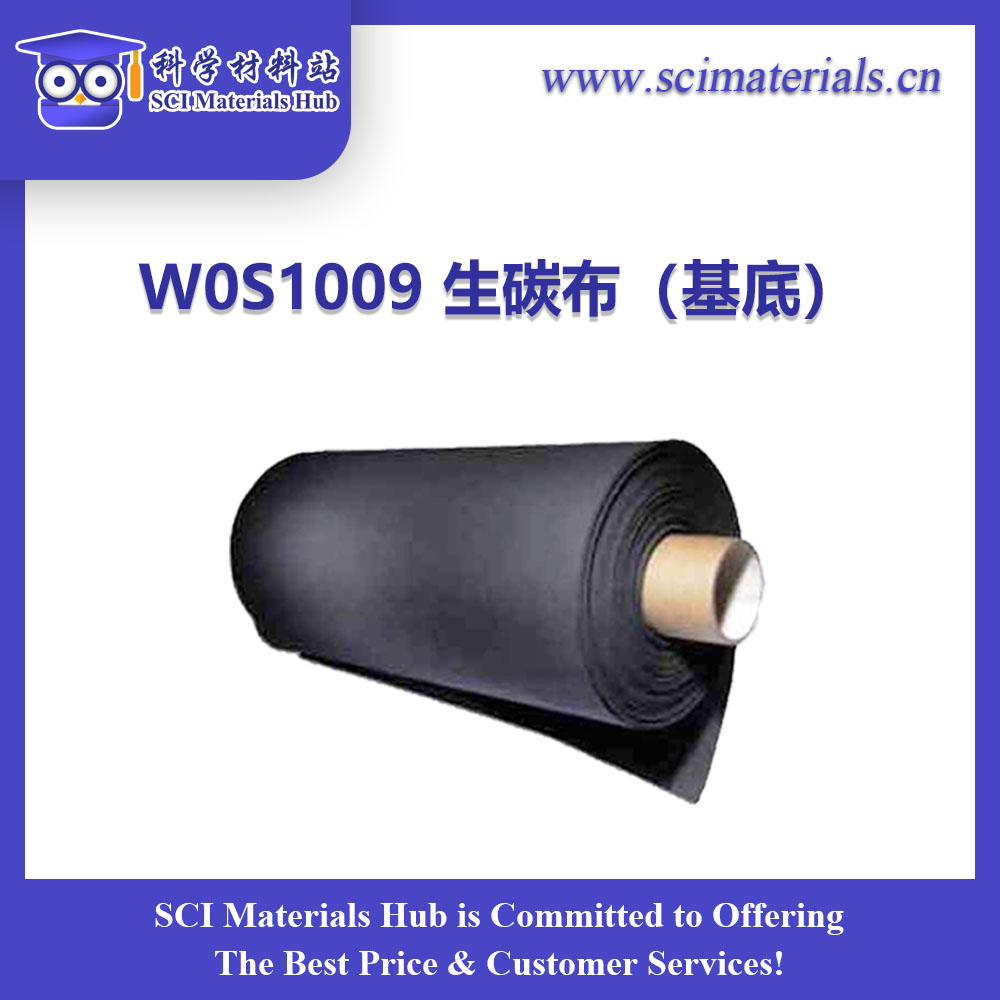
CeTech是一种没有微孔层(MPL)的编织碳纤维布。它的总厚度为330微米。CeTech是传统碳布气体扩散层(GDL)材料的低成本替代品。
更多介绍请阅读《科学材料站Z博士:亲水碳布知多少?》
科学材料站与碳能建立官方合作,成为其一级经销商,在全球范围内推广碳能全系列产品。
欢迎广大厂商、经销商询价,价格从优。
点击上方【购买渠道】进行购买或咨询
2. CeTech碳布的优点
高压缩性(高达100公斤/平方厘米)
自动质量控制检验系统
3. 特点:
(1)引导气体从石墨板的导流沟槽到触煤层;
(2)顺利把反应式产生物-水排除于触媒层之外,避免水淹问题;
(3)电流的传导器;
(4)在燃料电池反应时具散热功用;
(5)足够的强度支撑MEA当其因为吸水过多而变形。
4. 文章引用
欢迎在文章中引用从科学材料站(SCI Materials Hub)获取的材料
W0S1009 Carbon Cloth with a thickness of 0.33mm was obtained from SCI Materials Hub.
参数下载:
 Ce-Tech碳布对比:W0S1009 vs W1S1009.pdf
碳能CeTech W0S1009 生碳布特性 | |
材料类型 | 碳纤维编织布 |
厚度 | 0.330毫米(330微米) |
基本重量(克/平方米) | 120 |
透气度 | <10 |
电阻率(通过平面) | <5mΩ*cm2 |
抗拉强度 | MD:10 N / cm和XD:5 N / cm |
PTFE处理 | 无 |
微孔层 | 无 |
碳布一般采用PAN聚丙烯腈作为原料加以纺织,再经过高温处理而成。台湾碳能生产的W0S1009、W0S1011碳布是基础型碳布基底,呈弱疏水性,一般用作材料生长或负载的基底。如果有需要,可以采用不同方法如化学法(如硫酸浸泡等)、物理法,将疏水性碳布改性成亲水性碳布。
台湾碳能生产的W1S1009、W1S1010、W1S1011碳布是疏水微孔层处理型碳布,呈强疏水性,分别是在W0S1009、W0S1010、W0S1011基础型碳布表面涂布了微孔层MPL和PTFE,增强透气性,一般用作各类燃料电池如氢燃料电池的空气阴极。
如果客户希望将碳布用作燃料电池阴极,可以直接购买W1S1009、W1S1010、W1S1011碳布,自己负载催化剂层C即可,如果购买W0S1009、W0S1011碳布,除了负载催化剂层C外,还需要在碳布另外一面负载碳基底层A和气体扩散层B。
简要方法如下,文献参考:Cheng, S.; Liu, H.; Logan, B. E. (2006), Electrochemistry Communications 8, 489-494. A(碳布基底层)、B(PTFE即特氟龙扩散层)、C(Pt/C催化剂层)。下面就ABC的制作分别阐述:

A:涂覆碳基底层
1. 用小刀裁剪碳布4*8 cm(两块4*4 cm的阴极);
2. 按照1cm2碳布负载1.56 mg的标准,用电子天平称量50mg炭黑;
3. 按照1 mg炭黑对应12 uL 40%PTFE(特氟龙,聚四氟乙烯)的标准,用移液器取600 uL;
4. 将称量的炭黑加入一个小塑料瓶,放入6-8颗小玻璃珠,加入移取的PTFE,盖上瓶盖,摇晃20s,形成悬浮液;
5. 用刷子将悬浮液涂覆在碳布的一面,注意动作轻慢,避免炭黑进入碳布的另一面;
6. 将涂覆有炭黑的碳布放入一个硬纸板上,静置2h自然干燥,或者用一个电吹风加速;
7. 将自然干燥的碳布放在一个预热到370摄氏度炉子里面的高温陶瓷板上(注意一定要戴高温手套,避免烧伤),加热20-30 min;
8. 将高温陶瓷板从炉中拿出来,让碳布自然冷却,或者将炉关闭,炉门打开,缓慢降温;由于碳布上已经涂布了PTFE,碳布会变得更卷曲,这是正常现象。
B.涂覆扩散层(PTFE,即特氟龙,聚四氟乙烯)
(1)充分摇晃60%的PTFE,保证这种悬浮液充分混匀;
(2)将摇匀的60%PTFE溶液均匀涂覆在刚才的碳布那面;
(3)用毛刷去除任何气泡或大块PTFE;
(4)空气干燥5-10 min,干燥时涂覆面颜色变白;
(5)将涂覆有PTFE的碳布放入炉中370摄氏度加热10-15 min;
(6)将其自然冷却,颜色会变成亮黑色;
(7)再重复步骤(1)-(5)3次,使得PTFE涂层一共有4层,这是Z适宜的扩散层厚度;
(8)用剪刀裁剪出12cm2的圆形阴极碳布,或者用一个小铁锤击打木板模具获得这种12cm2的圆形阴极碳布;
C. 涂覆Pt/C催化剂
(1)称量10%的Pt/C催化剂,确保1cm2的碳布碳布有0.5 mg的Pt,比如12cm2的碳布需要6 mg Pt,需要60 mg的Pt/C催化剂;
(2)将称量好的Pt/C催化剂放入一个塑料瓶中,再按照1mg Pt/C催化剂配比0.83 uL的蒸馏水的比例,如60 mg的Pt/C催化剂需要50 uL的蒸馏水。将蒸馏水逐滴滴加到塑料瓶中,加6-8颗玻璃珠,摇晃20 s.这个步骤叫做Pt催化剂的“水处理”;
注意:如果水的量不够,或者没有摇匀,会使得Pt与Nafion膜中的乙醇反应,导致放热甚至起火;
(3)按照1 mg的Pt/C催化剂加入6.67 uL的Nafion溶液和3.33 uL的异丙醇比例,比如60 mg的Pt/C催化剂需要加入400 uL的5%的Nafion溶液和200 uL的异丙醇;
(4)将调好的糊状物涂覆在碳布的扩散层(PTFE)的另一面;
(5)将涂覆好的碳布空气干燥至少24h,或者用电吹风的低档加热以加速。
科学材料站与台湾碳能CeTech公司于2021年6月建立官方合作,将在全球范围内推广碳能全系列产品。供应质量优异的碳纸、碳布、石墨毡、钛纤维毡等产品,可以用于燃料电池膜组件、电极材料制备、纳米材料基底合成、液流电池等研究方向。
🛒 手机淘宝店铺:科学材料站
🔗 淘宝链接:点击进入淘宝网页
☎ 电话:+86 130-0303-8751 / +86 156-0553-2352
💬 微信:SCI-Materials-Hub
📧 Email 报价/对公需求:contact@scimaterials.cn
W0S1009 生碳布(基底) | |||
产品代码 | 产品描述 | 产品价格及规格 | 货期 |
| 121000 | W0S1009 Carbon Cloth without MPL | ¥99 (10cm*10cm,货号:121000-1010) ¥389 (20cm*20cm,货号:121000-2020) | 现货 |
SCI Materials Hub is Committed to Offering The Best Price & Customer Services! | |||
* 大量需求请联系我们咨询更多折扣
** 可提供13%增值税专用发票
*** 3平米及以上需求请联系我们咨询大量优惠价
SCI MATERIALS HUB
科研选材,选科学材料站
材料规格清晰,应用文献可查
Supplier names in the literature include SCI Materials Hub, Wuhu Eryi Materials Technology (an SCI Materials Hub company), Owl Materials Technology (an SCI Materials Hub company), and Wuhu Maotouying Materials Technology (an SCI Materials Hub company).
没有符合当前筛选条件的文献。
With nickel foam supplied by Wuhu Owl Materials Technology (an SCI Materials Hub company), the team built a core–shell cobalt selenide–hydroxide electrode for supercapacitors.
The authors sourced nickel foam from SCI Materials Hub and used a hydrogen-bond-regulated interface to improve seawater oxidation and durability.
The experiments used Fumasep FAB-PK-130 membrane from SCI Materials Hub, and the authors developed a co-deposited PdCu catalyst for electrochemical semi-hydrogenation of alkynols.
With Nafion D520 dispersion supplied by SCI Materials Hub, the researchers made an interface-rich nickel–cobalt alloy by flash Joule heating for alkaline hydrogen evolution.
The experiments used Vulcan XC-72 carbon black from SCI Materials Hub, and the authors improved CO tolerance in methanol oxidation by decorating porous platinum nanorods with amorphous bismuth sulfide.
The authors improved CO₂ electroreduction selectivity with high-index copper facets in Ag–Cu tandem catalysts in experiments that used Nafion NR212 membrane from SCI Materials Hub.
The experiments used 0.3 mm nickel foam from Wuhu Owl Materials Technology (an SCI Materials Hub company), and the authors built a binder-free NiTe₂/CoTe₂ electrode for chloride removal by capacitive deionization.
The study used AvCarb MB30 gas diffusion layer from SCI Materials Hub, and the team improved proton-exchange membrane fuel cells with an ionomer that interacts with surface dipoles.
The researchers characterized the structure, hardness, and ion release of a zinc-modified titanium alloy, with zinc nanopowder (about 50 nm) supplied by SCI Materials Hub.
The authors sourced carbon cloth from SCI Materials Hub and developed a porous hydrogel that improves moisture-driven power generation.
The experiments used Sigracet 28BC carbon paper and Nafion D520 dispersion from SCI Materials Hub, and the authors identified how calcium deposits affect oxygen reduction during peroxide electrosynthesis in natural water.
With Toray TGP-H-060 carbon paper and Nafion NR211 membrane supplied by SCI Materials Hub, the researchers improved nitrate reduction by introducing isolated antimony sites that promote lattice-nitrogen participation.
The authors separated the effects of platinum surface functionalization on cathode kinetics and mass transport in experiments that used GORE-SELECT M788.12 membrane and AvCarb GDS3250 carbon paper from SCI Materials Hub.
The study used Ketjenblack EC-300J carbon black from SCI Materials Hub, and the team reduced Nafion-induced poisoning of Pt₃Co fuel-cell catalysts by adding cerium.
The researchers reversed hydrogen spillover by tuning oxygen vacancies to improve interfacial hydrogen transfer, with Toray TGP-H-060H hydrophilic carbon paper supplied by SCI Materials Hub.
The authors sourced PiperION A35 membrane from SCI Materials Hub and evaluated crown ether-based membranes for durable alkaline electrolysis under fluctuating power.
The researchers used stainless-steel current collectors from Wuhu Maotouying Materials Technology (an SCI Materials Hub company) and improved aqueous zinc-battery cycling by regulating stress in manganese-substituted VOPO₄.
The experiments used copper foam from SCI Materials Hub, and the authors used interfacial ligands to improve both activity and selectivity in alkynol semi-hydrogenation and deuteration.
With Sustainion XA-9 ionomer dispersion supplied by SCI Materials Hub, the researchers showed how dynamic coordination in zinc–phosphorus nanodomains affects CO₂ reduction.
The authors demonstrated hydrogen peroxide electrosynthesis with a resin-wafer reactor without an anion-exchange membrane in experiments that used Hesen HCP135 carbon paper, Accelerate IrO₂, BP2000 carbon black, Nafion N115 membrane, Nafion D520 dispersion, and Sustainion X37-50 Grade RT membrane from SCI Materials Hub.
The study used Nafion NR211 membrane, PiperION A20 membrane, Nafion D521 dispersion, PiperION A25-HCO₃ ionomer dispersion, wet-proofed Toray TGP-H-090 carbon paper, and stainless steel fiber paper from SCI Materials Hub, and the team showed how surface hydroxyl structure governs water dissociation in bipolar membranes.
The researchers demonstrated salt-free hydrogen peroxide electrosynthesis in neutral electrolyte with confined Co–N₄ sites, with AvCarb GDS2230 carbon paper supplied by SCI Materials Hub.
The authors sourced copper foam from SCI Materials Hub and engineered fluorine-induced defects in Cu₃P to improve chloride removal.
The experiments used Toray TGP-H-060H(S) hydrophilic carbon paper from SCI Materials Hub, and the authors improved hydrogen evolution by tuning electronic coupling between ruthenium nanoclusters and ReS₂ nanosheets.
With 99.99% magnesium foil (200 µm) supplied by SCI Materials Hub, the researchers evaluated how albumin and shear stress affect corrosion of polymer-coated magnesium under simulated physiological flow.
The authors evaluated the performance and economics of vanadium flow batteries for long-duration storage in experiments that used Nafion NR212 membrane from SCI Materials Hub.
The researchers used commercial cation-selective membranes from Owl Materials Technology (an SCI Materials Hub company) and evaluated edge-sulfonated graphene oxide membranes for osmotic power generation.
The study used Johnson Matthey 20 wt% Pt/C catalyst, TANAKA PtCo/C catalyst (46.9 wt% Pt), and Ketjenblack EC-300J carbon black from SCI Materials Hub, and the team improved phosphate tolerance in a low-platinum, high-temperature PEM fuel cell.
The researchers improved CO₂-to-n-propanol conversion by combining nanoconfinement with grain-boundary engineering, with Nafion N115 membrane supplied by SCI Materials Hub.
The authors sourced Nafion D520 dispersion from SCI Materials Hub and developed a cobalt phosphide catalyst supported on nitrogen-doped coconut-shell carbon for alkaline hydrogen evolution.
The experiments used Sustainion ionomer dispersion (5 wt%) and Fumion FAA-3 ionomer (10 wt%) from SCI Materials Hub, and the authors demonstrated peroxide production from natural seawater at industrially relevant current densities.
With Toray TGP-H-060M carbon paper supplied by SCI Materials Hub, the researchers adjusted the CO-to-hydrogen ratio of syngas with Cu–In–Ag electrodes.
The authors favored multicarbon products in CO₂ electroreduction with a CuLa bimetallic catalyst in experiments that used Nafion perfluorinated resin solution (5–5.4 wt%) from SCI Materials Hub.
The study used Fumasep FKS-30 membrane from SCI Materials Hub, and the team improved electroosmotic flow in microfluidic chips through microscale pumping.
The experiments used 5 wt% Nafion dispersion and commercial Nafion membrane from Wuhu Eryi Materials Technology (an SCI Materials Hub company), and the authors developed an amino acid-functionalized membrane with higher proton conductivity and lower methanol permeability.
The researchers developed an amorphous NiCoFeMo phosphide catalyst for durable oxygen evolution, with Toray TGP-H-060H hydrophilic carbon paper supplied by SCI Materials Hub.
The authors sourced Fumasep FAB-PK-130 membrane from SCI Materials Hub and clarified how ionic-liquid cations and anions jointly affect copper-catalyzed CO₂ electroreduction.
The experiments used 20 wt% Pd/C catalyst and 40 wt% Au/C catalyst from SCI Materials Hub, and the authors demonstrated selective formaldehyde upcycling in acid by electrochemically mediated disproportionation.
With 0.05 mm carbon felt supplied by Wuhu Eryi Materials Technology (an SCI Materials Hub company), the researchers developed a phosphorus-activated organic cathode for high-capacity, long-life iron batteries.
The authors combined a porous flow field and a modified transport layer to improve PEM water electrolysis in experiments that used 250 µm titanium felt from Wuhu Eryi Materials Technology (an SCI Materials Hub company).
The study used lead foil, tin foil, and bismuth foil from SCI Materials Hub, and the team demonstrated reversible aqueous electrochemistry for heavy p-block elements with a salting-in electrolyte.
The researchers demonstrated reversible multielectron ammonium storage in a covalent organic framework, with 0.05 mm carbon felt supplied by Wuhu Eryi Materials Technology (an SCI Materials Hub company).
The authors sourced Vulcan XC-72R carbon black from SCI Materials Hub and improved acidic oxygen reduction with an iron- and nitrogen-containing carbon layer on biochar.
The study used a PtRu/blank half-membrane and Fumasep FAA-3-PK-130 membrane from SCI Materials Hub and 1 mm nickel foam from Wuhu Eryi New Materials (an SCI Materials Hub company) to investigate chloride repulsion during seawater electrolysis.
With Vulcan XC-72 carbon black supplied by SCI Materials Hub, the researchers improved methanol electrooxidation with Pt₂Bi₂/Pt heterojunction nanorods.
The authors improved CO₂ electroreduction in pure water by engineering the membrane–electrode interface in experiments that used PiperION ionomer solution, Sustainion ionomer dispersion, and IrOₓ-coated titanium electrode from SCI Materials Hub.
The authors evaluated nickel dispersed on liquid gallium for electrochemical nitrate-to-ammonia conversion in experiments that used Nafion N117 membrane from Owl Materials Technology (an SCI Materials Hub company).
The team sourced Nafion N117 membrane from SCI Materials Hub and co-produced formate by coupling CO₂ reduction with oxidation of PET-derived ethylene glycol.
The researchers improved hydrogen evolution by promoting charge transfer and hydrogen spillover on a tungsten oxide-supported catalyst, with Vulcan XC-72 carbon black supplied by SCI Materials Hub.
The authors sourced hydrophobic carbon paper from SCI Materials Hub and improved nitrate-to-ammonia conversion with a trimetallic catalyst derived from a metal–organic framework.
The experiments used Sigracet 36BB carbon paper from SCI Materials Hub to evaluate a system that couples seawater desalination with CO₂ reduction to formate.
With 20 wt% Pt/C benchmark catalyst supplied by Wuhu Eryi Materials Technology (an SCI Materials Hub company), the researchers improved alkaline hydrogen evolution by modifying Co/Co(OH)₂ nanosheets with molybdate.
The authors produced methane from dilute CO₂ in neutral electrolyte using densely spaced copper sites in experiments that used Nafion N117 membrane and Aquivion D79-25BS dispersion from SCI Materials Hub.
The study used 0.45 µm PTFE membrane from SCI Materials Hub, and the team used catalyst reconstruction to favor multicarbon products in CO₂ electroreduction.
The study used CeTech W0S1011 carbon cloth, Fumasep FKB-PK-130 membrane, and Fumasep FAS-PET-130 membrane from SCI Materials Hub and recovered ammonia from digestate with a membrane-free electrolyzer that concentrates ions.
The authors sourced nickel foam from SCI Materials Hub and identified silver-triggered Co⁴⁺ sites that promote electrocatalytic oxidation of alcohols to acids.
The experiments used AvCarb GDS2240 gas diffusion layer from SCI Materials Hub, and the authors controlled catalyst-site evolution through local hydrophobicity to improve CO₂ electroreduction.
With CeTech W0S1011 carbon cloth supplied by SCI Materials Hub, the researchers used laser writing to make a self-supporting MoNi₄–graphene electrode for enhanced urea oxidation.
The authors converted glycerol to propylene glycol at ampere-level current density in experiments that used Nafion N115 membrane from SCI Materials Hub.
The study used Toray TGP-H-060H hydrophilic carbon paper, Vulcan XC-72 carbon black, nickel foam, Nafion D520 dispersion, Nafion N117 membrane, and Fumasep FAA-3-PK-75 membrane from SCI Materials Hub, and the team used carbon defects to accelerate TEMPO redox cycling in urotropine electrosynthesis.
The researchers coupled electrocatalytic nitrophenol conversion with in situ product separation, with AvCarb G300A carbon felt supplied by SCI Materials Hub.
The authors sourced Nafion D520 dispersion from SCI Materials Hub and measured how nickel substitution in lanthanum cobaltite affects oxygen reduction.
The experiments used DiffuCarb CP-H200R carbon paper from SCI Materials Hub, and the authors tuned a Co₃O₄/CeO₂ interface to favor glycolic acid during glycerol oxidation.
The authors used a hydrogen-bond network to favor hydroxide transport over chloride during seawater splitting at 2.0 A cm⁻² in experiments that used 1 mm nickel foam from Wuhu Eryi New Materials (an SCI Materials Hub company).
With industrial-grade graphite felt, Nafion N324 membrane, Nafion N438 membrane, Nafion N117 membrane, and Nafion N115 membrane supplied by SCI Materials Hub, the researchers developed a metal-free solid-electrolyte electro-Fenton system for removing pharmaceutical and personal care pollutants.
The authors achieved over 98% Faradaic efficiency for CO at 500 mA cm⁻² with a nickel single-atom catalyst at pH 1 in experiments that used Nafion D520 dispersion, Nafion 212 membrane, Nafion N115 membrane, Sigracet 39BB gas diffusion electrode, and CO₂ humidifier from SCI Materials Hub.
With 1 mm nickel foam supplied by Wuhu Eryi New Materials (an SCI Materials Hub company), the team used borate-etched CoFe hydroxide to improve the stability of seawater electrolysis.
The study used Zirfon 220 separator and Zirfon 500 separator from SCI Materials Hub, and the team improved hydroxide conduction through two-dimensional hydrogen-bond networks.
The researchers developed a two-dimensional manganese–iridium oxide for oxygen evolution under acidic conditions, with Nafion NR212 membrane supplied by SCI Materials Hub.
The authors sourced nickel foam and nickel foil from SCI Materials Hub and improved glucose oxidation to formate by tuning the spin state of cobalt in nickel cobaltite.
The experiments used copper foam from SCI Materials Hub, and the authors coupled nitrate and CO₂ to produce urea with cobalt-doped palladium nanocrystals.
With CeTech W0S1009 carbon cloth supplied by SCI Materials Hub, the researchers cross-linked polyvinyl alcohol with lignin to make a flexible supercapacitor electrolyte for a broad temperature range.
The authors extended aqueous zinc-ion battery cycling with a separator made from bacterial cellulose and glass fiber in experiments that used 304 stainless steel foil from SCI Materials Hub.
The study used anion-exchange membrane water electrolyzer from Wuhu Eryi Materials Technology (an SCI Materials Hub company), and the team developed a metal–oxide heterojunction catalyst for anion-exchange membrane water electrolysis.
The researchers improved glucose sensing with a silver-nanowire and cobalt-oxide electrode, with CeTech W0S1011 carbon cloth supplied by SCI Materials Hub.
The authors sourced Sustainion XA-9 ionomer powder and PiperION A5 ionomer from SCI Materials Hub and clarified how ionomer–catalyst interactions enable efficient CO₂ electroreduction with pure water.
The experiments used carbon paper from SCI Materials Hub, and the authors anchored iridium within lanthanum-modified cobalt oxide for oxygen evolution with reduced iridium loading.
With Sigracet 39BB gas diffusion layer, Sustainion X37-50 Grade 60 membrane, and Sustainion XA-9 ionomer supplied by SCI Materials Hub, the researchers used oxide-derived silver to improve photovoltaic-driven CO₂ reduction in a membrane electrode assembly.
The authors stabilized the zinc anode of a zinc–iodine flow battery using a halide-rich electrolyte in experiments that used Nafion N115 membrane from SCI Materials Hub.
The study used nickel foam from SCI Materials Hub, and the team improved nitrate-to-ammonia conversion using boron-doped copper foam.
The researchers used Ketjenblack EC-300J carbon black from SCI Materials Hub and evaluated cobalt-doped RuIr nanoparticles for stable alkaline water splitting.
The researchers compared hydrogen evolution and durability in an alkaline test of foam electrodes for seawater electrolysis, with nickel–molybdenum foam, iron foam, nickel–iron foam, nickel foam, and platinum comparison electrode supplied by SCI Materials Hub.
The authors sourced BS01 operando battery pressure tester from SCI Materials Hub and engineered a carbon–zinc oxide host for lithium metal and tracked cell pressure during operation.
The experiments used nickel foam from SCI Materials Hub, and the authors deposited cobalt ferrite on nickel foam by aerosol-assisted chemical vapor deposition to improve oxygen evolution.
With Nafion D520 dispersion supplied by SCI Materials Hub, the researchers supported molybdenum carbide on nitrogen- and phosphorus-doped coconut-shell carbon for alkaline hydrogen evolution.
The authors used porous carbon-supported silver to improve mass transport during high-current CO₂-to-CO conversion in experiments that used Sigracet 39BB carbon paper, Sustainion X37-50 Grade T membrane, and nickel foam from SCI Materials Hub.
The study used Toray TGP-H-060 carbon paper, Nafion NR211 membrane, Nafion N117 membrane, and membrane electrode device from SCI Materials Hub, and the team controlled catalyst restructuring to improve ammonia electrosynthesis.
The researchers developed an electrolyte that disrupts two structures to enable practical cadmium-metal batteries, with Swagelok2E002 test cell, Swagelok3E2e test cell, Fueiceel BM03 battery test fixture, cadmium foil, zinc foil, and D-210C PTFE dispersion supplied by SCI Materials Hub.
The authors sourced CeTech W1S1011 carbon cloth from SCI Materials Hub and generated electricity from glycerol in a biofuel cell using galactose oxidase and bilirubin oxidase.
The experiments used Nafion NR211 membrane from SCI Materials Hub, and the authors tuned Ru–Co bond lengths through crystal-phase engineering to improve nitrate-to-ammonia conversion.
With CeTech W0S1011 carbon cloth supplied by SCI Materials Hub, the researchers built a nonenzymatic glucose sensor using graphdiyne oxide and gold nanoparticles.
The authors improved deuterated ammonia production by regulating the microenvironment of nitrate reduction in experiments that used hydrophilic carbon paper from SCI Materials Hub.
The study used Vulcan XC-72R carbon black, Sigracet 28BC carbon paper, and Fumasep FAA-3-50 membrane from SCI Materials Hub, and the team examined how to scale CO electrolysis for carbon-neutral chemical synthesis.
The researchers coupled electrochemical hydrogen peroxide production with catalytic oxygenation to achieve high reaction rates, with Sustainion ionomer binder and Sustainion X37-50 Grade 60 membrane supplied by SCI Materials Hub.
The authors sourced Nafion N117 membrane from SCI Materials Hub and improved propylene epoxidation with Ag₂O-modified MnO₂ and water as the oxygen source.
The experiments used Accelerate IrO₂ catalyst from SCI Materials Hub, and the authors measured and modeled hydrogen crossover in PEM water electrolysis at pressures up to 20 MPa.
With Vulcan XC-72R carbon black supplied by SCI Materials Hub, the researchers prepared ultrafine FePtCoNiRu high-entropy alloy particles for enhanced hydrogen evolution.
The authors combined cooperative Jahn–Teller distortion and long-range strain in a manganese oxide–graphene cathode for aqueous zinc-ion batteries in experiments that used zinc foil from SCI Materials Hub.
The study used Celgard 2400 separator from SCI Materials Hub, and the team built ion-conducting electrode interphases for a 4.7 V lithium-metal battery by regulating lithium-ion coordination.
The researchers used electric double-layer capacitors to reduce membrane use in electrodialytic ammonia recovery from digestate, with CeTech W0S1011 carbon cloth and Fumasep FKB-PK-130 membrane supplied by SCI Materials Hub.
The authors sourced Fueiceel BM03 battery test fixture from SCI Materials Hub and used alcohol molecules to control disorder in vanadium-based cathodes and improve rate performance and durability.
The experiments used 15 µm zinc foil from SCI Materials Hub, and the authors stabilized aqueous zinc-ion batteries with a localized eutectic electrolyte.
With Nafion D520 dispersion and Nafion N117 membrane supplied by SCI Materials Hub, the researchers demonstrated hydrogen peroxide electrosynthesis at an industrially relevant current density in a flow cell.
The authors built multidimensional carbon networks to improve composite bipolar plates in experiments that used Ketjenblack EC-600JD carbon black, CB11 acetylene black, and Vulcan XC-72 carbon black from SCI Materials Hub.
The study used Nafion N115 membrane from SCI Materials Hub, and the team stabilized zinc–iodine flow batteries by engineering anion-dominated solvation.
The researchers scaled up the conversion of waste PET into biodegradable polyglycolic acid plastic, with nickel foam and Nafion N117 membrane supplied by SCI Materials Hub.
The authors sourced nickel foam from Wuhu Eryi Materials Technology (an SCI Materials Hub company) and improved hydrogen production in a microbial electrolysis cell with a CoMo cathode.
The experiments used PiperION A15-HCO₃ membrane from SCI Materials Hub, and the authors used a hydrophobic ionomer to tune the electrode environment for efficient CO₂ electroreduction.
With Vulcan XC-72 carbon black, PTFE-treated Toray TGP-H-060 carbon paper, and Nafion N117 membrane supplied by SCI Materials Hub, the researchers improved CO₂-to-formate conversion with sulfur-modified bismuth oxyiodide.
The authors controlled cooling after Joule heating to improve oxygen evolution on high-entropy oxides in experiments that used carbon cloth from Wuhu Eryi Materials Technology (an SCI Materials Hub company).
The study used Nafion D520 dispersion from SCI Materials Hub, and the team used bromide mediation to synthesize ethylene carbonate from CO₂ and ethylene in a membrane-free cell.
The researchers chemically tuned a framework polymer membrane to improve anion transport and selectivity, with Sustainion X37-50 Grade RT membrane supplied by SCI Materials Hub.
With carbon paper supplied by Wuhu Owl Material Technology (an SCI Materials Hub company), the team improved acidic oxygen evolution on RuO₂ by tuning Ru–O bonding with cerium.
The authors sourced carbon-coated aluminum foil from SCI Materials Hub and constructed a graphene–nanotube–layered double hydroxide composite for lithium-ion batteries.
The experiments used Celazole PBI resin (MW 60,000) from SCI Materials Hub, and the authors developed lignin-derived cationic polymers for efficient high-temperature proton-exchange membrane fuel cells.
With Nafion D521 dispersion, 60 wt% PtRu/C catalyst, PiperION A5-HCO₃ ionomer, and PiperION A-type anion-exchange membrane supplied by SCI Materials Hub, the researchers directed cobalt coordination with alkali metals to form Co–N₄ sites in Co–N–C catalysts.
The authors reached 39.4% Faradaic efficiency for ethylene oxide using an Ag/SnO₂ interface that promotes ethylene activation and hydroxyl formation in experiments that used Fumion FAA anion-exchange resin and Fumasep FAA-3-50 membrane from SCI Materials Hub.
The study used zinc foil and 99.99% copper foil from SCI Materials Hub, and the team used a polymer-derived layer to direct zinc-ion diffusion and deposition in a hybrid supercapacitor.
The researchers integrated electrochemically assisted absorbers for CO₂ removal, with Sigracet 39BB carbon paper supplied by SCI Materials Hub.
The authors sourced AvCarb GDS 2230 and Nafion N1110 membrane from SCI Materials Hub and controlled cobalt phthalocyanine aggregation on carbon nanohorns to improve hydrogen peroxide production in neutral electrolyte.
The experiments used nickel foam from SCI Materials Hub, and the authors promoted oxygen evolution by inducing surface reconstruction in amorphous nickel boride.
With Spectracarb 2050A-1050 carbon paper supplied by SCI Materials Hub, the researchers improved hydrogen evolution by using cobalt doping to create low-valence rhodium sites.
The authors improved CO₂-to-formate conversion by restructuring bismuth under reaction conditions in experiments that used Fumasep FAA-3-50 membrane from SCI Materials Hub.
The study used Fumasep FAB-PK-130 membrane from SCI Materials Hub, and the team demonstrated ammonia electrosynthesis from nitric oxide at ampere-level current density in a pressurized cell.
The researchers used confined CuOₓ sites on titanium dioxide nanotubes to enrich dilute nitrate for ammonia synthesis, with Nafion N115 membrane supplied by SCI Materials Hub.
The authors sourced Fumasep FAA-3-PK-130 membrane from SCI Materials Hub and combined Rhodococcus with oxygen-doped carbon nitride to achieve photocatalytic partial nitrification.
The experiments used Celgard 2400 separator from SCI Materials Hub, and the authors designed a biodegradable gel electrolyte for high-rate, long-life sodium metal batteries.
With Nafion D520 dispersion, Nafion NR212 membrane, Nafion N115 membrane, Nafion N117 membrane, AvCarb GDS2230 carbon paper, and Spectracarb 2050A-1050 carbon paper supplied by SCI Materials Hub, the researchers demonstrated scalable neutral hydrogen peroxide electrosynthesis with Fe₃O₄ on nitrogen-doped carbon.
The authors combined boron doping and morphology control in flower-like CuO to improve CO₂ electroreduction in experiments that used Toray TGP-H-060 carbon paper, Nafion D520 dispersion, and Nafion N117 membrane from SCI Materials Hub.
The study used Fumasep FAA-3-20 membrane from SCI Materials Hub, and the team loosened hydrophobic regions to promote ion-channel formation in fuel-cell anion-exchange membranes.
The researchers constructed a hierarchical oxygen evolution electrode with NiFe hydroxide and nitrogen-doped cobalt on nickel foam, with commercial PtRu/C catalyst and commercial RuO₂ catalyst supplied by SCI Materials Hub.
The authors sourced nickel foam from SCI Materials Hub and prepared a high-activity oxygen evolution electrode by depositing iron, nickel, and vanadium oxides on nickel foam.
The experiments used Vulcan XC-72R carbon black from SCI Materials Hub, and the authors designed asymmetric selenium-based dual-atom sites for efficient oxygen reduction.
With Nafion N117 membrane supplied by SCI Materials Hub, the researchers improved zinc–manganese flow battery stability and energy density by controlling cations during MnO₂ reduction.
The authors demonstrated nickel phosphide as a non-noble cathode catalyst for hydrogen isotope separation in experiments that used nickel supported on Vulcan XC-72 from SCI Materials Hub.
The study used 5 wt% Pt/C catalyst, 10 wt% Pt/C catalyst, Ketjenblack EC-300J carbon black, GORE ePTFE-reinforced proton-exchange membrane, and gas diffusion layer from SCI Materials Hub, and the team showed that contact uniformity has a greater impact on fuel cells with low catalyst loading.
The researchers improved the oxygen evolution activity and stability of NiFe hydroxides by doping them with gallium, with nickel foam supplied by SCI Materials Hub.
The authors sourced Nafion N117 membrane from Wuhu Eryi Materials Technology (an SCI Materials Hub company) and prepared 5N-purity copper from an impurity-rich anode in one electrorefining step.
The experiments used Fumasep FAA-3-PK-75 membrane from SCI Materials Hub, and the authors demonstrated continuous electrochemical CO₂ capture with decoupled redox steps.
With Nafion D520 dispersion supplied by SCI Materials Hub, the researchers built a sensitive electrochemical lead-ion sensor from a bismuth MOF and conductive polymer composite.
The authors used a conductive metal–organic framework coating on the separator to suppress polysulfide shuttling and improve redox conversion in experiments that used Ketjenblack carbon black from SCI Materials Hub.
The study used carbon fiber cloth from SCI Materials Hub, and the team improved the corrosion resistance of TC4 titanium alloy with a superhydrophobic carbon-fiber composite coating.
The researchers coupled a formaldehyde–polyoxometalate battery with a two-step approach to hydrogen production, with copper foam supplied by SCI Materials Hub.
The authors sourced single-cell alkaline water electrolyzer from SCI Materials Hub and demonstrated more than 1,000 hours of high-rate alkaline electrolysis with a thin PVA-coated Zirfon-type separator.
The experiments used Ketjenblack EC-600JD carbon black from SCI Materials Hub, and the authors examined how manganese doping changes the electronic structure and electrocatalytic properties of SrCoO₃.
With CeTech W0S1011 carbon cloth supplied by SCI Materials Hub, the researchers prepared a hydroxypropyl methylcellulose gel electrolyte in one step for high-performance supercapacitors.
The authors developed an iron–molybdenum biochar cathode for long-lived zinc–air batteries in experiments that used Vulcan XC-72R carbon black from SCI Materials Hub.
The study used Sigracet 22BB carbon paper from SCI Materials Hub, and the team accelerated air-cathode reactions in neutral zinc–air batteries using photothermal heating.
The researchers examined how electrode substrate and sputtered copper thickness affect multicarbon selectivity in CO₂ reduction, with Sigracet 36BB carbon paper supplied by SCI Materials Hub.
The authors sourced CeTech W0S1011 carbon cloth from SCI Materials Hub and engineered multilevel nickel and iron sites on a carbon-cloth electrode for sensing multiple heavy metals.
The experiments used Nafion NR212 membrane and PiperION A20 membrane from SCI Materials Hub, and the authors identified the oxygen-containing groups on graphene oxide that accelerate water dissociation.
With nickel–iron foam supplied by SCI Materials Hub, the researchers engineered amorphous–crystalline NiFe layered hydroxide structures for high-current oxygen evolution.
The authors demonstrated redox-mediated separation of hydrogen production from direct seawater splitting in experiments that used nickel foam, 20 wt% Pt/C catalyst, Fumasep FAA-3-PK-75 membrane, graphite felt, and alkaline water electrolyzers from SCI Materials Hub.
The study used 20 µm titanium foil from SCI Materials Hub, and the team developed a charging-free electrochemical flow cycle for low-temperature thermoelectric conversion.
The researchers used reconstructed dual active sites in gelatin-derived nitrogen-doped porous carbon for efficient overall water splitting, with Nafion D521 dispersion supplied by SCI Materials Hub.
The authors sourced CeTech W0S1011H(M) carbon fiber cloth from Wuhu Eryi Materials Technology (an SCI Materials Hub company) and evaluated the wear and corrosion of anodized TC4 and carbon fiber composites in a marine environment.
The experiments used Vulcan XC-72R carbon black and PTFE-treated Toray TGP-H-060 carbon paper from SCI Materials Hub, and the authors achieved over 90% Faradaic efficiency for cyclohexanone oxime with a Cu–Mo dual-site catalyst.
With AvCarb G650A graphite felt supplied by SCI Materials Hub, the researchers demonstrated a membrane-free, biphasic zinc–iodine battery with high volumetric capacity.
The authors improved anion-exchange membrane electrolysis by modifying the carbon-paper diffusion layer in experiments that used nickel–iron foam from SCI Materials Hub.
The study used Toray TGP-H-060 carbon paper, Nafion D520 dispersion, and Nafion N117 membrane from SCI Materials Hub, and the team combined CuO with oxygen-deficient ceria nanospheres to improve CO₂ electroreduction.
The researchers improved photocatalytic hydrogen evolution by adding an AgCo cocatalyst to graphitic carbon nitride, with Nafion D520 dispersion supplied by SCI Materials Hub.
The authors sourced Nafion D520 dispersion from SCI Materials Hub and improved oxygen reduction catalysis by inserting carbon dots between MXene layers.
The experiments used Ketjenblack EC-600JD carbon black from SCI Materials Hub, and the authors generated hydrogen peroxide in a floating dual-cathode electro-Fenton system for removing organic pollutants.
With Fumasep FAAM-20 supplied by SCI Materials Hub, the researchers designed ruthenium on titanium nitride for efficient, stable alkaline hydrogen evolution.
The authors used a two-step synthesis to develop a low-platinum quaternary alloy for acidic methanol oxidation in experiments that used 5 wt% Nafion solution from SCI Materials Hub.
The study used aluminum tape current collectors from Wuhu Eryi Materials Technology (an SCI Materials Hub company), and the team used high-modulus carbon fibers to reduce internal resistance in structural supercapacitors.
The researchers identified a Cu⁰/Cu⁺/Cu⁰ interface that favors multicarbon products during CO₂ reduction at neutral pH, with Sustainion X37-50 Grade RT membrane and CRRMEA1a MEA electrolyzer supplied by SCI Materials Hub.
The authors sourced IrO₂ catalyst, 40 wt% Pt/C catalyst, Sustainion X37-50 Grade 60 membrane, and carbon fiber cloth from SCI Materials Hub and used flexible tungsten disulfide structures to improve hydrogen evolution in an anion-exchange membrane electrolyzer.
The experiments used CRRMEA1a 1cm2 MEA electrolyzer from SCI Materials Hub, and the authors used compressive strain in copper catalysts to favor multicarbon products during CO₂ electroreduction.
With 20 wt% Pt/C catalyst supplied by Wuhu Eryi Materials Technology (an SCI Materials Hub company), the researchers tuned reaction energy barriers in sulfur-doped nickel hydroxide on copper for efficient urea electrolysis.
The authors used electric-field-assisted corrosion to grow NiFe hydroxide nanosheets for high-rate oxygen evolution in experiments that used nickel–iron foam from SCI Materials Hub.
The study used Toray TGP-H-060 carbon paper from SCI Materials Hub, and the team improved oxygen evolution with oxygen-vacancy-rich amorphous transition-metal oxides.
The researchers used molten salt to form isolated metal sites for selective CO₂ reduction, with Nafion D520 dispersion and Sigracet 39BB carbon paper supplied by SCI Materials Hub.
The authors sourced commercial Nafion proton-exchange membrane from SCI Materials Hub and compared nylon cloth with a commercial membrane as a separator for microbial methane production.
The experiments used raw carbon paper from SCI Materials Hub, and the authors used one-step electrodeposition of a polymer–nanotube composite on carbon paper for scalable ascorbic acid detection.
With zinc sheet and Whatman GF/D glass fiber supplied by SCI Materials Hub, the researchers improved the structural stability of δ-MnO₂ in aqueous zinc-ion batteries by introducing chromium.
The authors demonstrated ampere-level CO₂ reduction across a range of pH values using doped bismuth sulfide in experiments that used CRRMEA1a 1cm2 MEA electrolyzer from SCI Materials Hub.
The authors developed a boron-doped graphene oxide cathode for toxicity detection in microbial fuel cells in experiments that used carbon black and CeTech W0S1011 carbon cloth from Wuhu Owl Material Technology (an SCI Materials Hub company).
The study used CeTech GDS250 carbon paper from SCI Materials Hub, and the team mapped hydrogen evolution activity across vanadium-based A15 superconducting alloys.
The researchers used silver-decorated CuO nanospheres to modify the reaction environment and promote carbon–carbon coupling, with Nafion D520 dispersion and Nafion N115 membrane supplied by SCI Materials Hub.
The authors sourced 5 wt% Nafion solution from SCI Materials Hub and evaluated boride-doped Pd–Ni/C catalysts for more active methanol oxidation.
The experiments used PiperION anion-exchange membrane from SCI Materials Hub, and the authors produced formate concurrently by coupling CO₂ reduction with glucose oxidation.
With single-crystal copper substrate supplied by SCI Materials Hub, the researchers grew wafer-scale, highly oriented nanotwinned silver on tailored copper substrates.
The authors tuned the reaction environment and in situ restructuring of copper catalysts for selective, stable production of multicarbon compounds in experiments that used CRRMEA5a from SCI Materials Hub.
The study used PSC2000 PEM electrolyzer stack from SCI Materials Hub, and the team evaluated treated wastewater as a feedstock for PEM hydrogen production.
The researchers used vanadium mediation to improve the areal capacity of a zinc–manganese flow battery, with zinc sheet, copper foam, and Ketjenblack EC-600JD carbon black supplied by SCI Materials Hub.
The authors sourced Toray TGP-H-060 carbon paper from SCI Materials Hub and developed an iridium–yttrium alloy catalyst for efficient acidic water electrolysis.
The experiments used GORE-SELECT M788.12 membrane and Fumasep FKB-PK-130 membrane from SCI Materials Hub, and the authors demonstrated continuous hydrogen production from seawater in a dual-cation-exchange membrane electrolyzer.
With PiperION A20 and Nafion N117 membrane supplied by SCI Materials Hub, the researchers made nanoporous bismuth by dealloying to improve CO₂ reduction to formic acid.
The authors controlled adjacent Cu and Cu₂O sites to favor hydrocarbon formation from CO₂ in experiments that used Nafion and Toray TGP-H-060 carbon paper from SCI Materials Hub.
The study used hydrophobic microporous laminated carbon paper (HML-CP) from Wuhu Eryi Materials Technology (an SCI Materials Hub company), and the team converted a mixed-metal hydroxide into a MOF/hydroxide catalyst for electro-Fenton degradation of sulfonamide antibiotics.
The researchers demonstrated hydrogen peroxide electrosynthesis at a low cell voltage, with Nafion N117 membrane, Nafion NR211 membrane, and Nafion NR212 membrane supplied by SCI Materials Hub.
The authors sourced 5 wt% Nafion solution from SCI Materials Hub and used CO spillover between ZnO and CuO to promote carbon–carbon coupling during CO₂ reduction.
The experiments used Fumasep FAA-3-20 membrane from SCI Materials Hub, and the authors used rigid spiro units to promote phase separation in an anion-exchange membrane.
With 20 wt% Pt/C catalyst supplied by Wuhu Eryi Materials Technology (an SCI Materials Hub company), the researchers tuned the electronic structure of Ni₄Mo/Cu to promote nonacidic hydrogen evolution.
The authors used a nanoporous polymer additive to form a protective interphase on a high-voltage LiCoO₂ cathode in experiments that used 16 µm carbon-coated aluminum foil from SCI Materials Hub.
The study used carbon cloth substrate from SCI Materials Hub, and the team improved water splitting by engineering interfaces among NiFe LDH, NiS₂, and VS₂.
The researchers demonstrated an aqueous alkaline zinc–sulfur flow battery, with Nafion N115 membrane supplied by SCI Materials Hub.
The authors sourced CeTech W0S1011 carbon cloth from SCI Materials Hub and developed a vanadium oxide cathode for aqueous zinc-ion batteries by engineering its morphology and defects.
The experiments used Fumasep FAA-3-50 membrane from SCI Materials Hub, and the authors identified detrimental interactions between activated-carbon and copper-oxide electrodes in an aqueous capacitor.
With CeTech W0S1009 carbon cloth supplied by SCI Materials Hub, the researchers improved hydrogen evolution across a wide pH range by decorating VS₂ with ruthenium.
The authors raised peak fuel-cell power density above 1.2 W cm⁻² by adding acid-based polymer layers to the catalyst layers in experiments that used Celazole PBI resin (MW 60,000), Sigracet 39BB carbon paper, and TANAKA 70 wt% Pt/C catalyst from SCI Materials Hub.
The study used 20 wt% Pt₃M alloy catalysts (M = Cr, Co, Cu, Pd, Sn, and Ir) from SCI Materials Hub, and the team combined modeling and experiments to explain how alloy electronic structure and interfacial electric fields affect oxygen reduction.
The researchers developed conductive composites that adhere at skin temperature and can be detached on demand, with Ketjenblack EC-600JD carbon black supplied by SCI Materials Hub.
The authors sourced Nafion N117 membrane from SCI Materials Hub and improved the utilization of nickel single atoms in CO₂ electroreduction with an interconnected network of nitrogen-doped carbon tubes.
The experiments used Ketjenblack carbon black from SCI Materials Hub, and the authors improved zinc plating and stripping reversibility by controlling charge density at the anode–electrolyte interface.
With copper foam supplied by SCI Materials Hub, the researchers tuned spinel-oxide valence through double exchange to improve oxygen evolution.
The authors developed an axially coordinated cobalt-phthalocyanine polymer as a bifunctional zinc–air cathode catalyst in experiments that used CeTech W0S1011 carbon cloth from SCI Materials Hub.
The study used nickel foam from SCI Materials Hub, and the team used dysprosium oxysulfide to withdraw electrons from the catalyst and promote oxygen evolution.
The researchers tuned copper oxidation states in MOF-derived catalysts to favor hydrocarbons in CO₂ electroreduction, with Nafion N117 membrane, Nafion D520 dispersion, and Toray TGP-H-060 carbon paper supplied by SCI Materials Hub.
The authors sourced Fumasep FAA-3-PK-130 membrane from SCI Materials Hub and developed crystalline–amorphous MoNi/NiMoOₓ interfaces for hydrogen evolution at industrially relevant rates.
The experiments used 0.35 mm porous fiber felts from SCI Materials Hub, and the authors improved the activity and durability of a RuO₂ anode for PEM water electrolysis by adding silver.
With single-reflection ATR crystal supplied by SCI Materials Hub, the researchers reconstructed a Prussian blue analogue to couple furfural oxidation with photo-assisted hydrogen evolution.
The authors improved mass transport for CO₂ electroreduction by confining the ionomer within the catalyst layer in experiments that used PiperION A5 ionomer, Fumion FAA anion-exchange resin, PiperION A15-HCO₃ membrane, and Fumasep FAA-3-50 membrane from SCI Materials Hub.
The study used Fumasep FAB-PK-130 membrane from SCI Materials Hub, and the team integrated confined molecular catalysts into gas diffusion electrodes for high-current CO₂ electroreduction.
The researchers demonstrated a rechargeable zinc–copper battery that uses chloride shuttling across a biphasic electrolyte, with CeTech W0S1011 carbon cloth, Celgard 2300 separator, Whatman GF/A glass fiber, Fumasep FAB-PK-130 membrane, and Nafion N117 membrane supplied by SCI Materials Hub.
The authors sourced carbon-paper gas diffusion electrode with 60% Pt/C from SCI Materials Hub and developed a mechanically reinforced proton-exchange membrane thinner than two micrometers.
The experiments used Vulcan XC-72 carbon black from SCI Materials Hub, and the authors used undercoordinated copper nanodots to produce polymer-grade ethylene from acetylene.
With Vulcan XC-72 carbon black, Nafion N115 membrane, Nafion D520 dispersion, AvCarb GDS 2230, and Spectracarb 2050A-1050 carbon paper supplied by SCI Materials Hub, the researchers improved acidic hydrogen peroxide electrosynthesis by placing epoxy groups next to cobalt active sites.
The authors favored ethylene production in CO₂ electroreduction by controlling grain boundaries in copper(I) oxide in experiments that used Toray TGP-H-060 carbon paper, Nafion D520 dispersion, and Nafion N117 membrane from Wuhu Eryi Materials Technology (an SCI Materials Hub company).
The study used zinc foil from SCI Materials Hub, and the team used amphoteric glycine to tune interfacial chemistry and improve zinc anode reversibility.
The researchers extended zinc–manganese dioxide battery life using a hydrophobic ion-conducting membrane, with zinc foil, carbon paper, and carbon felt supplied by SCI Materials Hub.
The authors sourced Sustainion X37-50 Grade RT from SCI Materials Hub and converted CO₂ to CO at low overpotential with partially nitrided nickel nanoclusters.
The experiments used Nafion D520 dispersion and CeTech GDL340 carbon paper from SCI Materials Hub, and the authors built a rechargeable aqueous zinc–air battery using a heterogeneous MoS₂ cathode catalyst.
With Toray TGP-H-060 carbon paper supplied by SCI Materials Hub, the researchers achieved 74.4% capacity retention after 500 cycles with a composite lithium anode in an NCA full cell, versus 34.4% with bare lithium.
The authors demonstrated gold as an effective cathode catalyst for hydrogen isotope separation in PEM water electrolysis in experiments that used 20 wt% Pt/C catalyst and 20 wt% Au/C catalyst from SCI Materials Hub.
The study used Fumasep FAB-PK-130 membrane, Nafion N117 membrane, CeTech GDL340, Sigracet 39BC, Nafion D520 dispersion, zinc foil, zinc powder, 20% and 40% Pt/C catalysts, and IrO₂ catalyst from SCI Materials Hub, and the team developed a high-voltage zinc–air battery with a hydrophobic design that suppressed proton shuttling.
The researchers demonstrated a photo-assisted rechargeable battery for desalination, with carbon cloth supplied by SCI Materials Hub.
The authors sourced Fumion FAA-3-SOLUT-10 ionomer from SCI Materials Hub and developed a rigid poly(ether sulfone) anion-exchange membrane with multiple cyclic ammonium groups for fuel cells.
The experiments used Fumasep FBM bipolar membrane, Sigracet 29BC carbon paper, Freudenberg paper H23C2, Nafion N117 membrane, and Fumasep FAA-3-PK-130 membrane from SCI Materials Hub, and the authors showed how differences in electronegativity between neighboring atoms affect CO₂ reduction selectivity.
With Nafion N324 membrane supplied by SCI Materials Hub, the researchers developed an electro-peroxone system with a solid polymer electrolyte to degrade plasticizers in natural waters.
The authors improved aqueous zinc-ion battery cycling with a nanofibrous coating on a manganese oxide cathode in experiments that used stainless steel foil and zinc foil from SCI Materials Hub.
The study used Fumasep FAA-3-50 membrane from SCI Materials Hub, and the team used isolated ruthenium atoms on tungsten trioxide to couple hydrazine oxidation with hydrogen evolution across a wide pH range.
The researchers used strain relaxation in nickel alloys to reach 96.6% Faradaic efficiency for CO in CO₂ reduction, with Fumasep FBM bipolar membrane supplied by SCI Materials Hub.
The authors sourced Vulcan XC-72R carbon black from SCI Materials Hub and improved electrochemical CO₂ reduction with atomically dispersed nickel sites.
The experiments used Fumasep FAA-3-50 membrane from SCI Materials Hub, and the authors identified the roles of isolated ruthenium sites in water dissociation and hydrazine dehydrogenation during alkaline hydrogen production.
With 20 wt% Pt/C catalyst supplied by SCI Materials Hub, the researchers enhanced hydrogen evolution through interfaces between amorphous nickel–molybdenum oxides and crystalline copper.
The authors compared functionalized nanotube–polyaniline cathodes for zinc-based energy storage in experiments that used carbon nanotubes from SCI Materials Hub.
The study used zinc foil from SCI Materials Hub, and the team used a hybrid aqueous–organic electrolyte to suppress zinc dendrites and corrosion.

|
为科学研究提供来源广泛的材料 材料合成仪器装置及材料解决方案 备案号:皖ICP备2021011042号-1 |
关于我们 |